
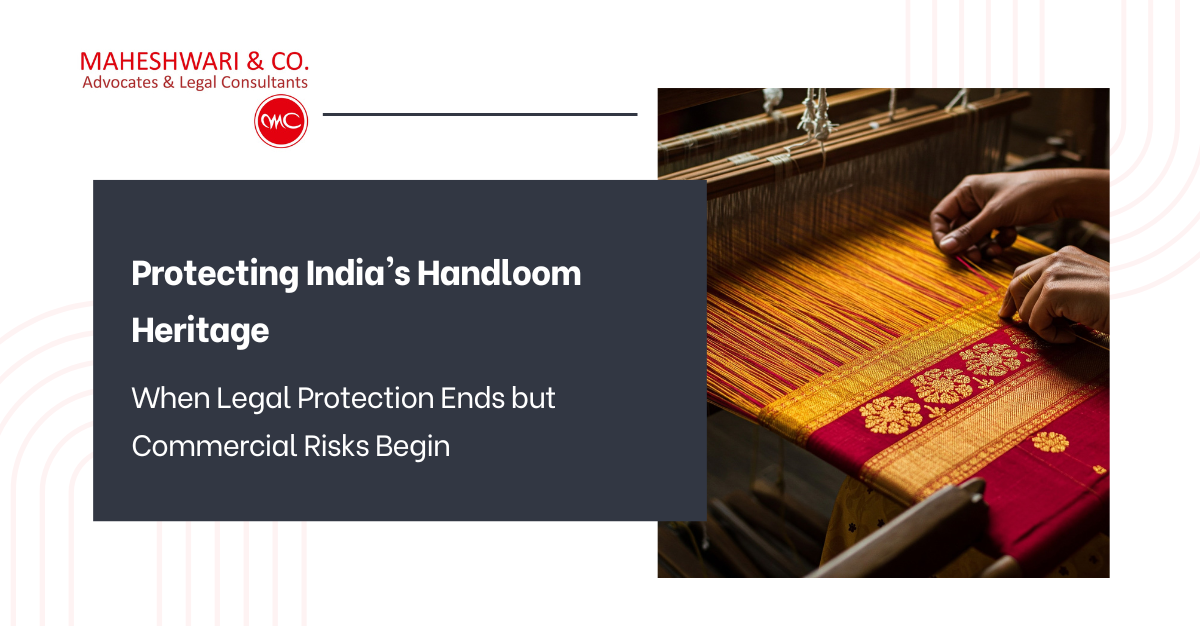

Step into any big shopping mall or open up an online e-commerce platform in India, and you will be overwhelmed with the number of “Banarasi” sarees made of silk, “Pochampally” ikats, and “Kanchipuram” silks. They are cheap, colorful, and easily available. However, the issue is that most of these items have not been produced using any traditional wooden loom. They are commercially manufactured in power loom factories, replicating the designs which were perfected by weaving communities over generations. It is not only unfair but also amounts to robbing them of their identity when a master craftsman takes three months in making one saree. Despite the substantial laws that India has established against such practices of Geographical Indications (GI) and Intellectual Property (IP), there is still a huge difference between the law and its application.
The Legal Framework: GIs and Handlooms
To know about the protection of the arts in India, one must first understand about the Geographical Indications of Goods (Registration and Protection) Act, 1999 that became effective from September 2003. The law was enacted in order to satisfy the country’s obligations in accordance with the TRIPS Agreement by the WTO. To put it simply, having a GI mark gives an authorized artisan from a particular region the right to use the traditional name of the said product. Should any other person outside the region sell similar goods, the registered weaver can file a lawsuit against them.
With the large amount of history in textiles in India, handlooms contribute to a substantial part of the list of geographical indications in the country. Examples of early registrations include the Kancheepuram Silk and the Pochampally Ikat both in 2004-2005 while Banaras Brocades came in 2009, covering six districts in Eastern Uttar Pradesh such as Varanasi, Mirzapur, and Azamgarh. It would seem that the tags give our weavers a monopoly over their traditional names.
How the Courts Have Interpreted GI Law
Due to the recent enactment of the GI Act, there is an ongoing process in India for the enforcement of the Act by the Indian Courts. In fact, the handloom industry has been at the centre stage for the very initial instances of litigation pertaining to Geographical Indications in the country.
The Pochampally Case
In 2005, the local weavers cooperatives of Pochampally instituted a lawsuit for infringement and passing off against the power-loom sarees which were being marketed under the brand name “HYCO Pochampally”. It was pleaded that the phonetically identical brand name could mislead the general consumer regarding the authenticity of handwoven ikat. A temporary injunction was obtained from the court, but the case was later settled out of court. This particular case marks the first ever infringement suit under the 1999 Act.
The Darjeeling Lounge Case
But sometime later, another significant loophole appeared not in the area of textiles but in the area of tea. In the Tea Board India v. ITC Ltd (2019), the Tea Board protested against the naming of a luxury bar in ITC’s hotel in Kolkata the “Darjeeling Lounge”. The case was dismissed by the Calcutta High Court since it found that the GI Act applies exclusively to goods and not services.
This limitation causes great damage to the handloom industry. If some luxury boutique or fashion designer uses the name of Kanchipuram or Banarasi for styling and designing their services, the weaver cooperatives will not be able to protect themselves with the help of the GI Act but have to file costly common law suits for passing-off or trademark dilution – which is simply impossible for poor weaver communities.
The Clash Between Copyright and Design Laws
While a GI label safeguards only the trademark, it does not safeguard the artistic design that is embedded within the fabric. For the safeguarding of this artistic design, weavers must understand the perplexing relationship between the two acts – Copyright Act, 1957 and Designs Act, 2000.
According to Section 2(c) of the Copyright Act, any artistic design of the textile is considered to be an “artistic work.” But the real shocker comes in Section 15(2), where it states that if the artistic design is industrially applied more than 50 times, then the copyright will become automatically void.
In the Microfibres Inc. v. Girdhar & Co. case, the Delhi High Court validated this tough fact. According to the court, as soon as the design reaches the market, regardless of whether it is registered or not, the design will not receive copyright protection if the design is meant to be used commercially. Therefore, traditional weavers can’t depend on automatic protection through copyright. They need to register each and every design through the Designs Act, which is a very bureaucratic and costly procedure.
In order to enable consumers to recognize the authentic products, the Ministry of Textiles introduced the Handloom Mark scheme in 2006. Moreover, Handlooms (Reservation of Articles for Production) Act, 1985, prevents the usage of power-looms in the production of some traditional articles such as some particular sarees, lungis, and durries. However, visiting any local cloth market will make one realize that the law is being violated everywhere.
The Reality on the Ground: Why Enforcement Fails
While India has filed for over 800 GI claims, the patent office’s certification cannot ensure market enforcement. Weaver cooperatives do not have the resources, manpower, or time to monitor online retail giants such as Amazon or Myntra nor send legal letters to power-loom manufacturers. Previously, in cases involving false Banarasi silks, it was discovered that the weavers on both sides of the equation – the copyists and the copiers – had absolutely no knowledge of the GI act at all.
Another huge loophole exists in terms of what is termed as “inspired.” When a power-loom mill manufactures an exact replica of the traditional Banarasi design but labels it as “Banaras-style sari” or “Inspired by Varanasi,” then they are not breaking the GI act because they are not branding their product as regional.
Conclusion
The Indian legislative protection mechanism for their heritage crafts is indeed commendable, considering that it covers everything from Geographical Indications (GIs), designs, certification marks, and also reservations. However, a legislative right becomes meaningless if the individual does not know of its existence or is unable to pay for legal aid. This is the major loophole within the legislative protection mechanism in India.
One solution is the setting up of legal mechanisms and their implementation through which grass-root level legal awareness campaigns, and financing of enforcement cells supporting weaver cooperatives along with cracking down on lookalike products sold in the retail market will take place. It is imperative for us to treat our textile tradition not like an artifact kept in a museum but rather a vibrant economic industry providing means of living for millions of people in rural areas.
Finally, technology has to be used in order to authenticate goods. Using QR codes to track handloom products and digital certifications associated with authorized producers using blockchains to establish authenticity is one solution.
Author: Akshi Seem, Associate Partner
Co- Author: Tanisha Jain and Chaitanya kumar, Intern