
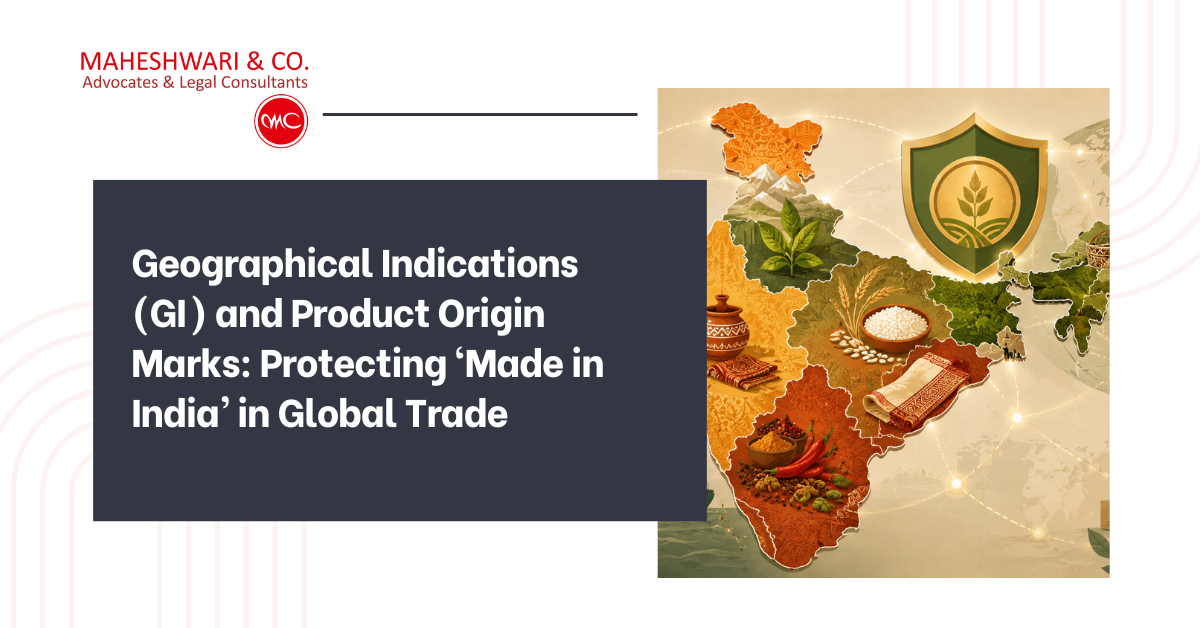

The sovereign identity of a nation assumes great significance while assessing the products offered by that nation in today’s globalized world. “Made in India” tag on a product does not merely mean its place of manufacture but also encompasses factors like cultural background, craftsmanship, and geographical characteristics of the place where it was made. This means that such origin tags receive legal protection and are exploited in business through two important modes of intellectual property:
- Geographical Indications (GIs)
- Product Origin Marks.
Although these two systems may appear similar in function, they do indeed differ in purpose. The geographical indications indicate an association between the characteristics of the product and its unique geographical setting. On the other hand, the product origin marks represent the national aspect of the products without necessarily indicating a geographical location. It is important that the two systems are combined for the realization of higher economic values in the international market, protection of indigenous knowledge, and development of MSMEs.
Economic value of the GI is measured by the extra price that can be commanded due to the association of the good with a particular place of geographical significance. The extra price is determined by the base price, extra value gained because of geographical significance, and costs incurred during the process of international protection.
The legal basis of GI in India is established under the clause of 2(1)(e) of the “Geographical Indication of Goods (Registration and Protection) Act” of 1999. According to this clause, a geographical indication is described as an indicator which denotes that the products – either agricultural, natural, or industrial – are made in a certain geographic territory, region, or location. A crucial factor in this definition lies in the terroir relationship between the product and its geographic origin, wherein terroir includes factors like soil, climatic conditions, etc.
Nonetheless, this relationship may face certain difficulties, primarily through environmental factors like climate change. In such cases, the product may no longer meet its established standards, resulting in what can be described as a “degraded” or weakened GI. This framework is also aligned with India’s obligations under international law, especially Article 22 of the TRIPS Agreement.
At the global level, intellectual property systems classify origin-based labels according to the strength of their geographical link:
Appellations of Origin (AOs): Governed by the Lisbon Agreement, these require a strict and direct connection between the product’s qualities and its geographic environment.
Geographical Indications (GIs): Recognised under TRIPS and Indian law, these allow for a relatively flexible link.
Indications of Source: These simply identify the place of origin without requiring any specific quality linkage (e.g., “Made in India”).
Although the “Made in India” label indicates national origin, GIs and AOs are vital for ensuring product quality and equitable benefit-sharing among stakeholders such as farmers and artisans. A major complication, however, arises from the fact that geographical features often extend beyond political borders. For example, Basmati rice is produced in India and Pakistan; thus, India cannot have sole rights in some foreign markets.
While TRIPS has created some basic rules regarding GIs, it has a hierarchical approach to the protection. Although Article 22 offers basic protection, Article 23 gives better protection in the case of wines and spirit products. It creates a disadvantage for developing countries, where the problems include genericide of a product.
In addition to GIs, India also promotes manufacturing identity through initiatives like “Make in India.” Under the Trademarks Act, 1999, certification marks can be registered to verify specific standards. However, confusion arises between “Make in India” and “Made in India.” The former is a government-authorised label for companies meeting domestic manufacturing criteria, whereas the latter simply denotes origin. In practice, “Make in India” operates like a certification mark but has been registered as a standard trademark, potentially creating legal vulnerabilities, particularly in international disputes where its descriptive nature may be challenged.
Furthermore, India lacks a robust regulatory framework to ensure the authenticity of “Made in India” products. Large manufacturers may qualify for this label even if only minimal production processes, such as final assembly, occur within the country. This weakens the link between origin and value, undermines genuine producers, and risks damaging the reputation of GI products.
An examination of India’s GI system reveals additional structural concerns, particularly in the registration process. The law establishes a dual system:
Registered Proprietors (Part A): Typically, associations or organisations representing producers.
Authorised Users (Part B): Individual producers such as farmers, artisans, or weavers.
Although both groups have rights to use and enforce GIs, practical challenges remain. A significant proportion of GIs are controlled by government bodies, which can limit the direct economic benefits reaching actual producers. Notably, well-known GIs like Darjeeling tea and Basmati rice fall under such arrangements.
At the international level, India faces strategic decisions regarding participation in global frameworks. The Lisbon Agreement (1958) and its revised Geneva Act (2015) offer an international mechanism for protecting geographical indications through a multilateral process. Though initially designed only for Appellations of Origin, the Geneva Act has since evolved into covering GIs and sought to create uniformity regarding enforcement within member countries.
However, despite the many strengths of this international arrangement, India has opted out. One reason is that joining this arrangement could automatically mean that foreign GIs are recognized, which may dilute the reputation of Indian goods possessing the same properties. Furthermore, it poses a contradiction to TRIPS provisions.
Future efforts should be directed at reinforcing “Made in India.” It is essential that standards of authenticity become clearer and that mechanisms for protection become more rigorous. As important, international cooperation must be fostered. Just as important, there should be a balanced approach to benefit sharing between farmers and artisans who produce such goods.
Author: Akshi Seem, Associate Partner,
Co- Author: Madhulika Bhaskar, Intern and Akshyat Das, Intern