
Abstract
Under the new framework, the beneficial ownership test will be applied at the level of the investor entity. Non-controlling beneficial ownership of up to ten percent from land bordering country investors will now be permitted under the automatic route, subject to sectoral caps and entry conditions. Transparency is preserved through mandatory reporting obligations, investee entities must disclose relevant information to the Department for Promotion of Industry and Internal Trade. Equally important is the introduction of a sixty-day timeline for processing proposals in specified manufacturing sectors. Capital goods, electronic capital goods, electronic components, and polysilicon and ingot-wafer production have been identified as critical areas where approvals must be expedited. The requirement that majority shareholding and control remain with resident Indian citizens or entities owned and controlled by them ensures that strategic industries remain under domestic oversight, even as foreign capital is welcomed to strengthen capacity and technology integration.
Introduction
India’s foreign direct investment framework has seen a remarkable shift in recent years. It has reshaped the way India interacts with global capital and how investors approach the Indian market. For decades, India’s policy trajectory was largely about liberalization i.e., opening up sectors, easing restrictions, and signaling to the world that it was ready to welcome foreign participation. But the last few years have introduced a new layer of caution and control, reflecting both geopolitical realities and domestic priorities.
One of the most significant turning points was Press Note 3 of 2020, which mandated prior government approval for investments from countries sharing land borders with India. It was a strategic safeguard, designed to prevent opportunistic acquisitions during the pandemic and to protect sensitive industries from hostile takeovers. Alongside this, India has continued to refine its sectoral approach. Manufacturing, renewable energy, and infrastructure remain open with 100% FDI under the automatic route, but defense, telecom, insurance, and media are subject to caps and approvals, underscoring the government’s intent to keep a tight grip on areas tied to national security and public interest.
Pre-Amendment Scenario
Around April 2020, Press Note 3 (“PN3”) was introduced to prevent opportunistic takeovers during the pandemic by requiring prior government approval for any investment originating from countries sharing land borders like China, Bangladesh, Bhutan, Pakistan, Nepal Myanmar, and Afghanistan (“LBC”) with India or where beneficial ownership was traced to such jurisdiction.
In simple words, a non-resident entity can invest in India, subject to the FDI Policy except in those sectors/activities which are prohibited. However, an entity of a country, which shares land border with India or where the beneficial owner of an investment into India is situated in or is a citizen of any such country, can invest only under the Government route, also called as Approval Route. Further, a citizen of Pakistan or an entity incorporated in Pakistan can invest, only under the Government route, in sectors/activities other than defense, space, atomic energy and sectors/activities prohibited for foreign investment.
While protective in intent, the broad sweep of PN3 created uncertainty for global private complicating equity and venture capital funds with even minor exposure to investors from these countries, slowing inflows and complicating transaction structures.
In addition to this, other factors that contributed to challenges associated with PN3 were that the term “Beneficial Ownership” was not defined, which meant that investors and advisors had to rely on analogous definitions under other applicable laws.
Further, the approval process did not operate within a defined timeline, which created uncertainty and lead to frictions in cross-border transactions.
Post Amendment Scenario
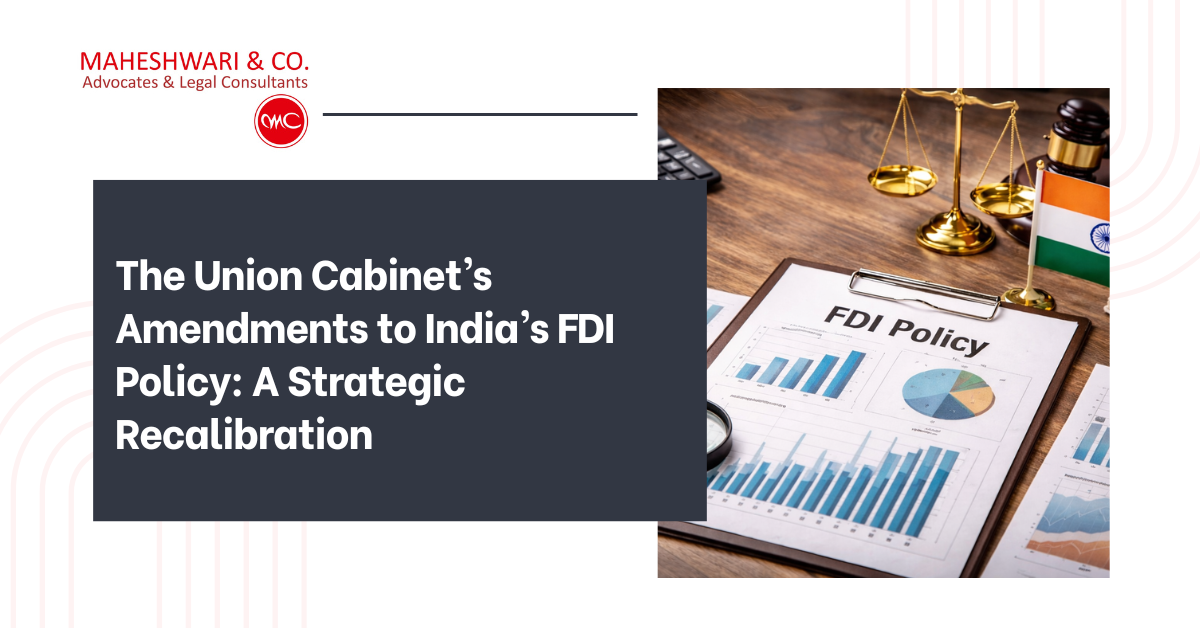
The Union Cabinet has approved a set of amendments to India’s Foreign Direct Investment policy that mark a decisive shift from the restrictive framework introduced under PN3 of 2020.
The amendment to the existing policy provides for a definition and criteria for determination of “beneficial ownership” that is widely used by investing community, under the Prevention of Money Laundering Rules, 2005.
The Beneficial Ownership test shall be applied at the level of the investor entity. Investor with non-controlling LBC Beneficial Ownership of up to ten percent (10%) shall be permitted under the automatic route as per the applicable sectoral gaps, entry routes, attendant conditions. Such investments shall be subject to the reporting of relevant information by the investee entity to Department of Promotion of Industry and Internal Trade.
Further, proposals for LBC investments in specified sectors/activities of manufacturing in capital goods, electronic capital goods, electronic components, polysilicon and ingot-wafer, shall be processed and decided within 60 days.
It is pertinent to note that in these cases, the majority shareholding and control of the Investee entity will be resident Indian citizen(s) and/or resident Indian entity(ies) owned and controlled by resident Indian citizen(s), at all times.
The new guidelines will provide clarity and ease of doing business in India, and facilitate investments which can contribute towards greater FDI inflows, access to new technologies, domestic value addition, expansion of domestic firms and integration with global supply chain.
Author – Mr. Ketan Joshi, Associate Partner
Co-Author – Ms. Navya Saxena, Associate
Reference
chrome extension://efaidnbmnnnibpcajpcglclefindmkaj/https://www.dpiit.gov.in/static/uploads/2026/03/b9da5830b052c2f2d788593e97d07c63.pdf