
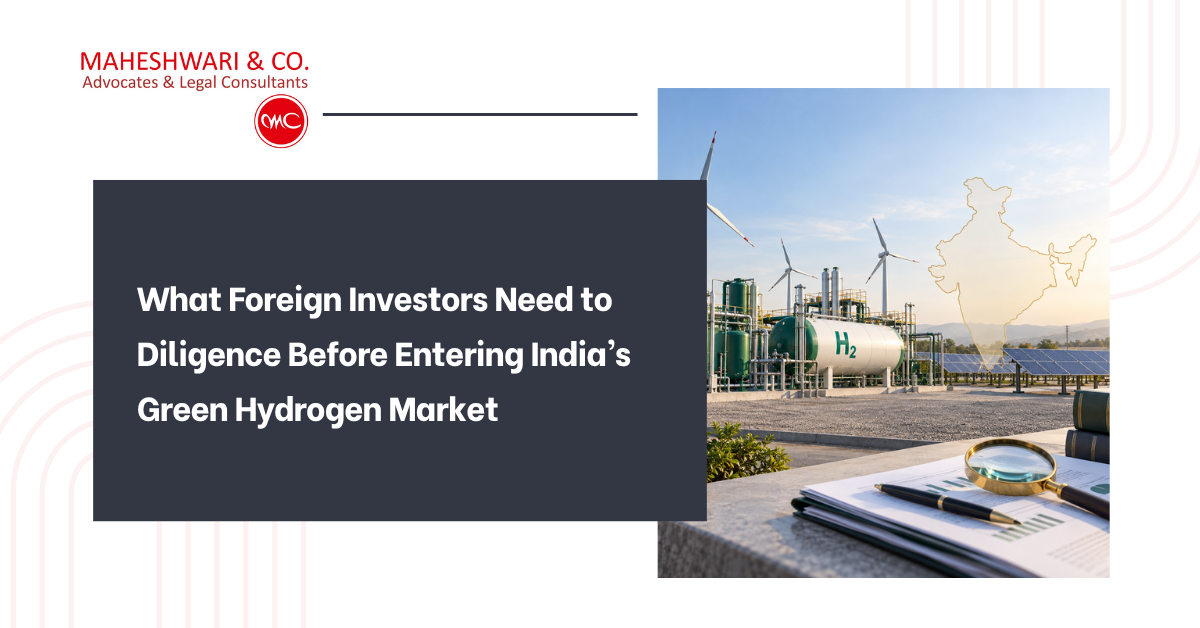

India is entering the next big energy renaissance with the National Green Hydrogen Mission (“NGHM”). The mission has transformed the country’s hydrogen ambitions from policy intent to transactional reality. For the entrepreneurs, it is not just an environmental solution, it is one of the most powerful future business avenues of the decade. With tenders now being awarded, price benchmarks being established, and states competing for investment, foreign investors are no longer evaluating a nascent sector. They are navigating an evolving regulatory market. The business offers long-term contracts, high-revenue generating potential, and massive scalability for early entrants. With a desire to position India as a global hub for clean hydrogen, the sector creates a massive first-mover advantage for entrepreneurs to enter early, capture market share, and build a cutting-edge, future-ready, energy business.
In comparison to the already established energy verticals, Green Hydrogen in India lies at the intersection of various regulatory domains such as renewable energy, hazardous chemicals, explosives, environmental clearance, land, state industrial policy, and emerging carbon market framework, none of which was originally developed with hydrogen in mind. Investors who view this simply as an “ESG compliance exercise” may underestimate the risks that determine project bankability.
This article outlines the principal due-diligence areas a foreign investor, whether a strategic offtaker, a private equity sponsor, or a project developer should investigate, before investing capital in an Indian Green Hydrogen or green ammonia project.
Regulatory Architecture
The NGHM comprising a budget of INR 19,744 crore and a target of 5 MMT of annual production of green hydrogen by 2030 provides the policy framework but, it does not by itself constitute a project license. Effective due diligence means unpacking it into its various operative components.
Under the SIGHT Scheme (Component I and II), incentives for electrolyzer manufacturing and green hydrogen/green ammonia production are disbursed through competitive bidding mechanisms. As per the latest disclosures, a combined 3,000 MW per annum of electrolyser manufacturing capacity has been awarded to 15 companies, while 8,62,000 Metric Tonnes per annum (MTPA) of green hydrogen production capacity has been allocated across 18 companies. These figures change with each tender round, and hence, investors must establish the tranche and mode as per which the project’s incentive entitlement was awarded. Moreover, award figure must be checked as of the diligence date rather than relying on figures published in an earlier information memorandum. The amount of incentive, duration, and trigger conditions differ significantly between rounds.
The next area of due diligence relates to the standards applicable in India for qualifying hydrogen as “green”. This requires verifying that the proposed production pathway of the project including water treatment, electrolysis, purification, drying and compression complies with the applicable emissions threshold of 2 kg CO₂-equivalent per kg of hydrogen or less, measured on a well-to-gate basis. As pricing, offtake terms and incentive eligibility criteria depend on the hydrogen qualifying as “Green Hydrogen,” any failure to meet the certification requirements would encounter a material bankability risk.
Equally important is verifying that the project’s certification methodology, certifying entity and supporting documentation complies with both India’s Green Hydrogen certification requirements as well as the statutory requirements of the buyer jurisdiction. This is especially important for EU-bound exports, where qualification as a Renewable Fuel of Non-Biological Origin (RFNBO) under EU rules is subject to additional criteria. Hence, an Indian certificate confirming “Green Hydrogen” status may not be sufficient to establish that the product qualifies as an RFNBO for a EU off taker.
There are also various sector-specific guidelines that need to be adhered to. Steel, shipping, transport, and HVIC/Hydrogen Hubs, each have their own eligibility criteria, land requirements, reporting obligations, in addition to the underlying NGHM framework. According to the latest disclosed status, four pilot projects have been approved for hydrogen use in steel production, 12 pilot projects have been sanctioned for deployment of 70 hydrogen-fuelled vehicles, 16 refuelling stations across 21 routes, and four Hydrogen Valley Innovation Clusters have been selected in Jodhpur, Odisha, Pune and Kerala. These developments signal a shift from policy ambition to sector-specific deployment, thereby also contributing towards India’s climate ambitions.
Since the regulatory framework is evolving in real time various standards and rules still under development, due diligence should verify whether the relevant laws, regulations, standards and government policies are currently in force and up to date.
Licensing Requirements and Sectoral Compliance
Before assessing the green hydrogen project itself, investors should first undertake corporate and licensing due diligence, which means verifying whether all necessary licences and approvals are in place.
An investor should not assume that the same FDI rules apply to every part of a green hydrogen project. Instead, the applicable FDI route should be verified for the specific activity including hydrogen production, electrolyzer manufacturing, ammonia/urea-linked operations, or port infrastructure. This is because conditions can vary across these categories, especially where fertilizer or explosives-adjacent activities are engaged.
For a green hydrogen project, hazardous chemical authorisations are also required since hydrogen is highly flammable and possesses explosive properties. Entities must secure prior authorisation from the relevant Central or State Pollution Control Board before manufacturing or importing hydrogen. Due diligence should verify that the requisite authorisation has been secured, rather than merely applied for. Project proponents must submit safety and audit reports timely to the concerned authorities. Further, even the storage and labelling facilities represented in the application should match with the infrastructure constructed at the site.
Hydrogen storage, transportation and dispensing infrastructure may be subject to different Petroleum and Explosives Safety Organisation (PESO) licensing requirements, depending on the equipment use, configuration and installed capacity. The Gas Cylinders Rules, 2016 establishes the licensing framework for hydrogen cylinders and, pursuant to the 2025 amendments, extend the licensing mechanism to Compressed Hydrogen Gas (CHG) dispensing stations through the new Form H licence. Separately, the Static and Mobile Pressure Vessels (Unfired) Rules, 2016 govern specified bulk hydrogen installations, including bulk compressed-hydrogen systems and bulk liquefied-hydrogen systems. The latter category expressly applies to liquified hydrogen storage systems exceeding 1,000 litres in capacity. Diligence should assess each hydrogen storage, transport and dispensing component on site against the relevant PESO regime, licence and approved configuration, rather than assuming that a single licence governs installation.
State policies can introduce additional requirements relating to land, electricity, fiscal incentives and administrative procedures requirements over and above the central NGHM framework. Eligibility for a general renewable-energy incentive does not automatically qualify as establishing eligibility for a State-specific Green Hydrogen incentive. The applicable policy or notification should be examined separately to determine the eligibility criteria, application requirements, commissioning timelines, incentive ceilings and sunset provisions. Diligence should also confirm whether the relevant incentive has been formally awarded or is merely existing in principle, and whether the project is legally entitled to combine State incentives with applicable central support.
Environmental Clearance
Pursuant to recommendations made by the sectoral Expert Appraisal Committee (“EAC”) in 2023, the Ministry of Environment, Forest and Climate Change clarified issued a clarification in July 2023 that standalone plants producing Green Hydrogen or Green Ammonia using electrolysis of water powered by Renewable Energy are exempt from the requirement of prior Environmental Clearance under the EIA Notification, 2006. This clarification is frequently cited in information memoranda as a blanket exemption. Diligence should test whether the target meets the conditions of the exemption.
The exemption is confined to standalone plants. Where a Green Hydrogen or Green Ammonia plant is situated within the same premises as an existing unit subject to prior Environmental Clearance (“EC”), the plant must be incorporated by way of an amendment to the existing EC. The EAC’s examination of IOCL’s proposed Green Hydrogen facility at its Panipat refinery demonstrates this distinction. Therefore, due diligence should ascertain the project’s actual configuration and integration with the existing unit, rather than relying on its description as “standalone.”
An EC exemption does not dispense with other environmental requirements. The July 2023 clarification preserves the need to obtain applicable Air and Water Act consents and other statutory permissions. Diligence should confirm the project’s CPCB/SPCB classification, consent requirements and applicable waste-management obligations, including the Hazardous and Other Wastes Rules, 2016, where applicable.
State-level and site-specific requirements should also be assessed, including any land-use, protected-area, forest, wildlife, wetland, coastal or other environmental restrictions that could influence project development, construction or operation.
Land and Water: Two Structural Constraints
Land
Land allocation, land-use conversion and associated approvals are largely governed at the State-level, which means that the investor needs to deal with the relevant State land laws and authorities. Large-scale renewable energy and electrolyser projects can require substantial land parcels. Therefore, land availability can materially affect whether the project is viable. Investors should verify title, land-use and conversion status, and confirm that any concessional lease has been documented through an executed deed. They should also determine whether the developer bears land-acquisition costs and timing risks. A policy-level assurance of land availability should not be construed as legally secured project land.
Water
Electrolysis requires purified or deionised water, while several high-potential renewable-energy regions also face significant water scarcity. Diligence should assess site-specific water availability, legal entitlement, source, quality, treatment capacity, and ensure that the financial model adequately reflects water-treatment costs. The impact of off-site water sourcing and treatment for Green Hydrogen certification should also be assessed.
Off-Take And Revenue Security
For early-stage Green Hydrogen projects, a credible long-term buyer is fundamental to bankability. Investors should verify whether the project has entered into a binding long-term offtake agreement and whether the contracted pricing and volumes are sufficient to cover project costs and financing obligations.
The investor should examine the executed offtake agreement to confirm contract duration, volumes, pricing structure, payment, termination rights, and assess the buyer’s creditworthiness.
Price, technology and export risk should also be assessed before investing in a green hydrogen project. Investor must compare the agreed price with relevant market benchmarks and evaluate whether the technology can reliably deliver the contracted volumes. For export projects, diligence entails verifying that the product qualifies under the destination market’s certification, traceability and emissions framework.
The central question is whether the project has a credible offtaker, an enforceable contract and a commercially viable pricing structure capable of generating a predictable revenue.
Infrastructure, Port and Logistics Diligence
For export-oriented projects, there is a need to establish that the necessary port, storage, grid and transport infrastructure is operational or contractually secured, rather than simply proposed.
Investors should assess port capacity and charges, timelines for grid-connectivity, and rights of access to shared storage, pipeline and terminal infrastructure. For shipping or HVIC-linked projects, diligence should confirm the relevant infrastructure, project status and applicable eligibility or reporting conditions.
The fundamental question is whether the infrastructure will be available, operational and economically viable when the project needs it.
Cross-Border Structuring: Certification, Carbon Accounting and Treaty Considerations
Given India’s strong export ambitions for Green Hydrogen and its derivatives, investors should evaluate Indian certification requirements against that of the destination market, particularly the EU’s RFNBO framework and the applicable clean-hydrogen standards in Japan and South Korea. Indian certification may not independently confer eligibility in the destination market, and variations in carbon-intensity methodologies can affect export economics.
Investors should also evaluate any carbon-border measures applicable to the hydrogen or hydrogen-derived products, as well as the scope of available bilateral investment treaty protections and dispute-resolution mechanisms. As the regulatory framework continues to evolve, these protections should be assessed together with contractual safeguards against regulatory and certification changes.
Conclusion
India’s Green Hydrogen ecosystem has progressed beyond policy intention towards price discovery and early-stage commercialisation, while its regulatory framework including MNRE standards, licensing, State incentive regimes and certification frameworks, continues to mature alongside the first wave of projects and transactions.
For foreign investors, this presents significant investment opportunities but also requires diligence that extends beyond the traditional renewable-energy due-diligence. Projects best positioned to remain bankable despite contractual and cross-border regulatory risks will be those where investors independently verify the regulatory requirements, land and water rights, offtake arrangements and export-certification pathway, rather than relying on announced incentives or headline commitments.
References:
- FICCI-EY, India’s Green Hydrogen Ecosystem: Strategic Opportunities, Key Challenges, and Demand Potential, August 2025 Investment opportunities in India’s Green Hydrogen sector | EY – India
- EU Delegated Regulation on Renewable Fuels of Non-Biological Origin (RFNBO): Commission Delegated Regulation (EU) 2023/1184 Delegated regulation – 2023/1184 – EN – EUR-Lex
Author: Jyotsna Chaturvedi, Head – corporate Practice
Co- Author: Aishwarya Jha, Advocate