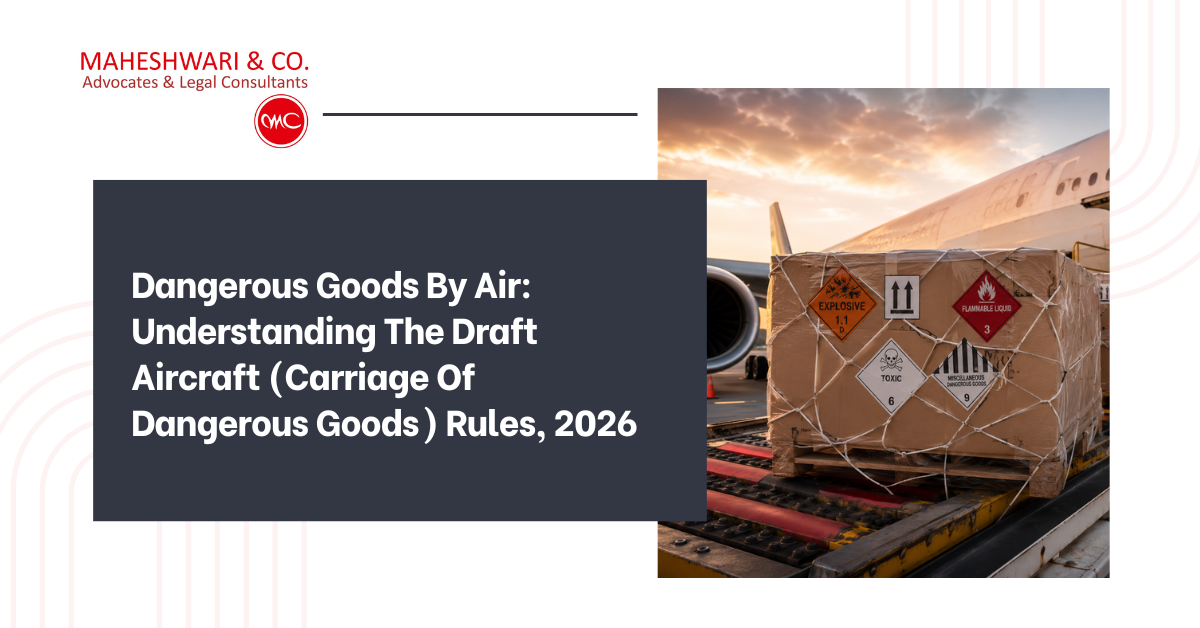

The Ministry of Civil Aviation on 17th February 2026 notified the Aircraft (Carriage of Dangerous Goods) Rules, 2026 (the “Rules”), replacing the earlier Aircraft (Carriage of Dangerous Goods) Rules, 2003. The Rules have been framed under the Bharatiya Vayuyan Adhiniyam, 2024 and establish a comprehensive regulatory framework governing the transportation of dangerous goods by air to, from, within and over India.
The Rules shift the regulatory approach from a predominantly compliance-oriented framework to a certification-driven and accountability-based regime, with defined oversight cycles, formal approvals and structured enforcement powers.
The term “dangerous goods” refers to articles or substances which are capable of posing a hazard to health, safety, property or the environment and which are listed as such in the Technical Instructions or which are classified according to the Technical Instructions.
Key Features of the New Regulatory Framework
The Rules introduce a comprehensive framework governing the carriage of dangerous goods by air, with a particular emphasis on certification, regulatory approvals, operational safety, training, and oversight. They also align India’s domestic regime more closely with international aviation standards by incorporating the requirements of the Technical Instructions and establishing clear responsibilities for operators, shippers, training organizations, and other stakeholders involved in the transport of dangerous goods.
- The provisions of these rules apply to:
- to aircraft registered in India or aircraft operated by an operator whose principal place of business or permanent place of residence is in India, wherever such aircraft may be
- to all aircraft for the time being in or over India
- to persons operating air transport services to, from, within and over India, shippers of dangerous goods or their agents; and
- designated postal operator.
- One of the most significant requirements introduced under the Rules is that no operator shall engage in the carriage of dangerous goods unless certified by the aeronautical authority of its State of the Operator.In the event, the State of the operator is India, the Director General of Civil Aviation (DGCA) may, certify an operator for carriage of dangerous goods. And in case, the State of the operator is not in India, such certified operator shall not carry dangerous goods to or from India without prior approval of the Director General.For an operator seeking certification, such operator shall file for an application for certification, permission, exemption or approval to the Director General in the form and provide for documents as specified by him along with the fee determined under these rules. The certification or approval shall, unless suspended or cancelled, remain valid for a period not exceeding five years, which may be renewed for a period not exceeding five years at a time.An operator who already holds the certification, prior to the commencement of these Rules, may continue to carry dangerous goods to or from India but shall obtain an approval of the Director General within six months from the date of commencement of these rules. No operator shall carry and no person shall cause or permit to be carried in any aircraft to, from, within or over India or deliver or cause to be delivered for loading on such aircraft any dangerous goods, except in accordance with and subject to the requirements specified in the Technical Instructions.
- Further, the carriage of explosive and radioactive materials by aircraft to, from, within, or over India is permitted only in accordance with the applicable provisions of the Adhiniyam and subject to prior written permission granted by the Central Government. Such carriage must also comply with the relevant provisions governing explosives and Section 16 of the Atomic Energy Act, 1962, as applicable.
- In situations such as national or international crises, natural calamities, or other emergencies necessitating the transportation of dangerous goods by air, strict compliance with the Technical Instructions may not always be feasible and may adversely affect the public interest. In such circumstances, the DGCA or an authorized officer may grant exemptions, provided that an equivalent level of safety is maintained.
Compliance and Operational Obligations
Beyond establishing a certification and approval framework, the Rules further impose extensive operational, compliance, and governance obligations on all stakeholders involved in the transportation of dangerous goods by air. These obligations span the entire lifecycle of carriage—from packaging and acceptance of dangerous goods to loading, transportation, unloading, incident reporting, personnel training, and regulatory oversight.
- Dangerous goods must be packed in accordance with the Technical Instructions, which prescribe detailed standards designed to ensure the safe handling and transportation of such goods by air. Compliance with these requirements is critical, as improper packaging can pose significant risks to aircraft operations, passengers, crew, property, and the environment. In particular, the packaging shall:
- be of good quality and suitable for the nature of the goods so as to prevent leakage during normal transportation conditions;
- be suitable for the contents resistant to chemical reactions with the contents
- meet prescribed testing standards; and
- ensure safe containment of dangerous substances.
Each package must also bear the appropriate shipping name, UN number and prescribed markings and labels. English must be used in addition to any language required by the State of Origin.
- Aircraft operators carry significant compliance obligations at every stage of cargo handling, from acceptance through to post-flight inspection.
- An operator cannot accept dangerous goods without a completed transport document and must physically inspect each package, overpack, or freight container for damage or leakage. This inspection must follow a formal acceptance checklist, which operators are required to develop and maintain. Any package that appears damaged or is leaking must not be loaded.
- Once goods are accepted, operators must ensure they are loaded and stowed correctly. Incompatible substances that could react with each other must be kept apart. Radioactive materials require prescribed separation from passengers, live animals, and undeveloped film. All packages must be secured against shifting during flight, particularly those containing radioactive materials, where movement could compromise separation requirements. Dangerous goods are strictly prohibited from passenger cabins and flight decks, with narrow exceptions set out in the Technical Instructions.
- Inspection does not end on the ground. After unloading, packages must again be checked for damage or leakage. If any is found, the area of the aircraft where the goods were stowed must also be examined for contamination. Any hazardous contamination discovered on the aircraft must be removed promptly. Aircraft contaminated by radioactive materials must be taken out of service immediately and cannot return until radiation and contamination levels fall within the limits specified in the Technical Instructions.
- The Rules establish a robust reporting framework. Operators and associated entities must report instances of misdeclared or undeclared dangerous goods to the DGCA. Such reports shall contain prescribed particulars regarding the shipper, nature of the goods and circumstances in which the non-compliance was discovered.
- Similarly, dangerous goods accidents and incidents must be reported to the DGCA, following which investigations may be ordered and preventive measures directed. The Rules also require operators to provide critical information relating to dangerous goods to pilots, emergency responders, air traffic services and relevant authorities in the event of accidents, serious incidents or emergencies.
- It is critical that all persons responsible for transporting dangerous goods must be trained prior to carrying out their duties. This responsibility rests on the shoulders of the employers, and they must make sure that their personnel is qualified for the job and it must be renewed after every twenty-four months.
- Any dangerous goods training programme formulated by an Indian organization airline, postal company, or another type of organization must receive approval from the DGCA, and the validity such approval shall be for a period of two years and must be renewed after the expiration date. Foreign operators may have their training programmes recognized where they can demonstrate that such programmes have already been approved by the competent aviation authority in their home jurisdiction.
- The DGCA and authorized personnel of the department are vested with powers to oversee and enforce that the compliance of the Rules. They may enter premises, inspect the aircraft, equipment, and documentation of the operations, perform inspections and investigations, and take other actions necessary for ensuring compliance. All stakeholders including airlines, shipper, training organizations, and postal companies, shall extend complete co-operation during the inspections, audits and investigations.
- The Rules further require operators, entities engaged in the carriage of dangerous goods, and approved training organisations to designate a qualified person responsible for ensuring compliance with the Rules. This requirement reflects the broader emphasis of the Rules on accountability and continuous compliance oversight.
Conclusion
Aircraft (Carriage of Dangerous Goods) Rules, 2026, represents a significant step towards modernizing the regulatory framework governing air transport of dangerous goods in India. By aligning the domestic requirements with international standards, making robust rules for certification, enhancing the training obligations and the regulatory oversight system, the Rules seek to promote the safe and efficient carriage of dangerous goods by air, while reinforcing accountability across the aviation ecosystem.
Jyotsna Chaturvedi, Head – Corporate Practice
Author: Shyamli Shukla, Senior Associate
Co- Author: Shagun Gupta, Intern