
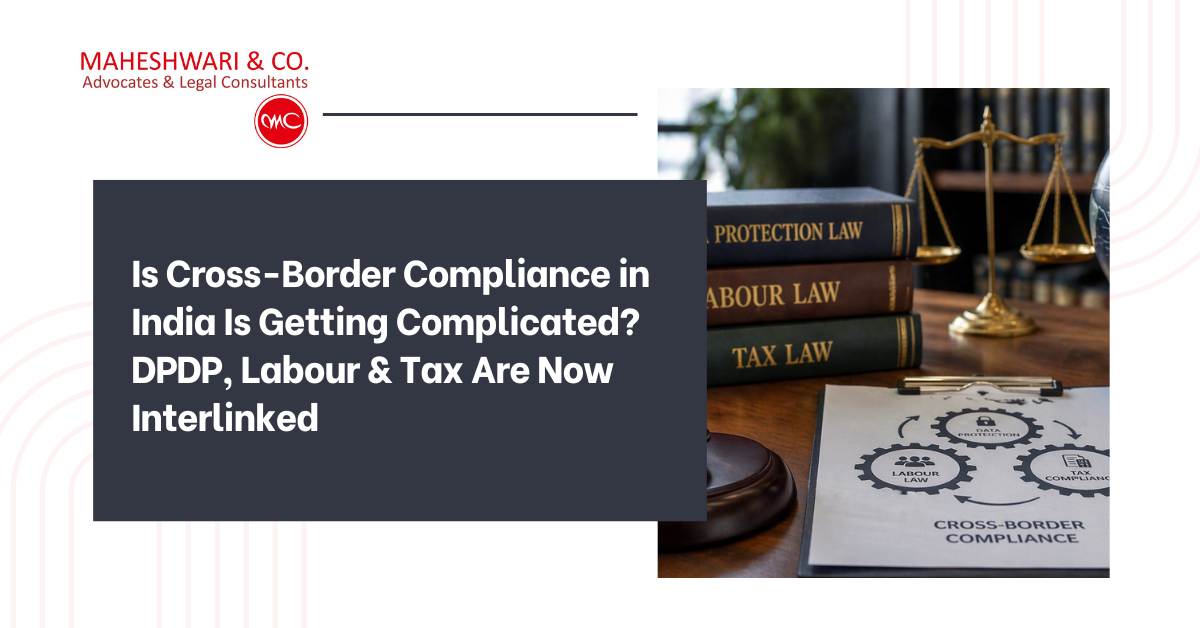

If your business operates across borders, compliance in India is now a moving, overlapping system. What used to be handled separately by legal, HR, and finance teams is now deeply interconnected.
A single cross-border transaction, whether it involves employee data, overseas vendors, or global service delivery, can simultaneously trigger DPDP compliance, labour law compliance in India, and cross-border tax compliance.
The real challenge today isn’t understanding each law in isolation. It’s managing how they intersect.
The New Compliance Reality
Cross-border operations today typically involve three parallel layers:
- Data flows → regulated under the Digital Personal Data Protection framework
- People & workforce → governed by Indian labour laws and Labour Codes
- Money flows → scrutinised under tax and international taxation rules
These layers don’t operate independently anymore. They overlap in real-time business scenarios.
Example:
An Indian team handling global HR operations:
- Processes employee data → triggers DPDP compliance
- Employs staff in India → triggers labour law compliance in India
- Bills overseas entities → triggers cross-border tax compliance
Why the Compliance Burden is Rising
The core problem is that cross-border business activity rarely fits neatly into one legal bucket. A company may send employee data to a global HR platform, second staff to another country, pay foreign vendors, or run India-based teams serving overseas clients. Each step can implicate a different legal regime, and each regime expects a different kind of control: consent and security under DPDP, wage and service-condition compliance under labour law, and residency, withholding, treaty, and transfer-pricing review under tax law.
India’s DPDP framework is especially important in this overlap because the Act is expressly designed to operate alongside other laws. Section 38 says the Act is “in addition to and not in derogation of” other laws, and where there is conflict, the DPDP Act prevails to the extent of the conflict. Section 16 also allows the Central Government to restrict transfers of personal data to notified countries or territories outside India, while preserving higher-protection restrictions in other Indian laws.
DPDP Compliance now Reaches Beyond the Privacy Team
The DPDP Rules, 2025 were notified on 13 November 2025, but their provisions do not all begin on the same day. Rules 1, 2 and 17 to 21 came into force on publication; Rule 4 comes into force one year later; and Rules 3, 5 to 16, 22 and 23 come into force eighteen months later. That staggered rollout means businesses cannot treat DPDP as a one-time legal update. They need a phased implementation plan that tracks notices, consent handling, security safeguards, breach processes, and vendor controls.
The operational burden is also more detailed than many companies expected. The rules require notices to be understandable on their own and written in clear, plain language, with enough detail for specific and informed consent. They also require an easy withdrawal path, comparable to the way consent was given. On the security side, the minimum safeguards include encryption, obfuscation, masking or virtual tokens, access controls, logging and monitoring, backups, and appropriate contractual and organisational measures. The breach rules are equally demanding: affected individuals must be informed without delay, and the Board must receive an immediate intimation plus a detailed follow-up within 72 hours.
That matters in cross-border setups because data does not move alone; it moves with payroll vendors, HR platforms, customer support tools, cloud storage, analytics providers, and finance systems. If a business sends employee or customer data outside India, it must think about the DPDP transfer restriction, the contractual chain with processors, and the possibility that another Indian law imposes a stricter rule. In practice, this means data mapping, vendor due diligence, incident response, and retention policies must now be aligned across jurisdictions, not handled department by department.
The Digital Personal Data Protection framework has significantly expanded the scope of compliance for cross-border businesses.
Key DPDP Compliance Requirements
- Clear, informed, and specific consent through structured notices
- Lawful processing of personal data
- Mandatory security safeguards (encryption, access control, logging)
- Data breach reporting obligations
- Vendor and processor due diligence
- Cross-border data transfer checks
Labour Compliance adds Another Layer, Especially for Global Workforces
Labour compliance is not becoming simpler either. The Ministry of Labour and Employment has stated that labour is a subject in the Concurrent List, and that both the Central and State Governments have rule-making roles under the Labour Codes. The Ministry’s 2026 FAQs also state that the Labour Codes’ implementation date is 21 November 2025. That matters because global employers cannot assume one uniform payroll model will work everywhere in India.
The revised wage definition is a good example of how labour compliance spills into finance and HR. The Ministry’s FAQs say the definition of “wages” under the Labour Codes came into effect from 21 November 2025, and that gratuity calculation is linked to that date. The same FAQs also clarify that overtime eligibility applies to employees, and that fixed-term employment covers employees directly engaged by the employer. Those points matter for cross-border groups that rely on contractors, shared-service models, or entity-level secondments, because worker classification directly affects pay, benefits, and statutory exposure.
So a global business cannot treat an India payroll file as just a payroll file. The payroll team may be dealing at the same time with wage definition, gratuity exposure, overtime rules, fixed-term contracts, local registrations, and employee-data handling under DPDP. That is exactly why cross-border compliance is becoming more expensive: one operational change can trigger three legal reviews.
Where Labour Law Overlaps with Cross-Border Work
- Remote employees serving foreign entities
- Secondment arrangements
- Fixed-term employment contracts
- Gig and contractual workforce models
- Payroll structuring for global roles
Misclassification of employees in cross-border setups can lead to liabilities across wages, benefits, and statutory dues.
Tax Compliance Completes the Triangle
Tax law introduces a separate but equally overlapping layer. The Income Tax Department’s official guidance states that residence is central to taxability, and that for a non-resident, income accruing or arising outside India is generally not taxable in India, while income accruing or deemed to accrue in India, or received in India, is taxable. The Department’s international-taxation pages also link cross-border compliance to transfer pricing, DTAA analysis, withholding tax, and mutual agreement procedures.
Transfer pricing is especially important where India-based teams transact with related foreign entities. The Income Tax Department explains that transfer pricing applies to international transactions between associated enterprises and to certain other specified transactions. In plain terms, when a cross-border group shares services, IP, support functions, or cost allocations, tax authorities will look at whether the pricing reflects arm’s-length principles.
That is where the overlap becomes operationally painful. An India-based team handling global HR services may process employee data under DPDP, employ staff under the Labour Codes, and invoice an overseas affiliate under transfer-pricing rules.
A foreign vendor paid from India may trigger withholding tax analysis, treaty review, and personal-data vendor controls at the same time. In a secondment or remote-work arrangement, the same individual may raise questions about employment classification, payroll withholding, data access, and whether the arrangement creates a tax presence or pricing issue for the group.
Core Areas of Cross-Border Tax Compliance
- Residential status determination
- Withholding tax (TDS) obligations
- Double Taxation Avoidance Agreements (DTAA)
- Transfer pricing regulations
- Permanent establishment (PE) risks
What Businesses Should do now?
The safest approach is to stop managing DPDP, labour, and tax as isolated workstreams. Cross-border businesses should maintain one integrated compliance map showing what data is collected, where it flows, who processes it, which workers are engaged directly or through contractors, which countries are involved, and which payments are cross-border or related-party in nature. That map should then feed separate controls for privacy notices and security safeguards, employment and payroll compliance, and withholding/transfer-pricing review.
They should also align contracts across departments. DPDP expects processor safeguards and incident-response obligations; labour arrangements must reflect the correct worker status and wage structure; and tax contracts must support arm’s-length pricing, treaty analysis, and documentation. In a cross-border environment, the weakest contract often becomes the weakest compliance link.
Conclusion
Cross-border business in India is no longer governed by a single legal lens. Data protection, workforce regulation, and tax compliance now intersect in ways that can create serious risk if handled separately. A routine commercial decision may simultaneously trigger DPDP compliance, labour law compliance in India, and cross-border tax compliance obligations.
Businesses that continue to treat these areas as isolated functions are more likely to face regulatory gaps, delayed responses, contractual inconsistencies, and avoidable disputes. The smarter approach is integrated compliance planning, where legal, HR, finance, and operational teams work from one coordinated framework.
As India strengthens its regulatory ecosystem, companies with cross-border operations must move from reactive compliance to strategic governance. Those who adapt early will not only reduce legal exposure but also build stronger, more scalable international operations.
FAQs
Why is Cross-Border Compliance Becoming Harder in India now?
Because the same business activity can trigger multiple Indian regimes at once. DPDP now has notified rules with staggered commencement, labour compliance has entered a new phase with the Codes’ implementation date and revised wage-linked calculations, and international tax compliance still requires residency, withholding, treaty, and transfer-pricing analysis. Businesses that move data, people, and money across borders need one coordinated compliance design, not three disconnected ones.
Does DPDP Stop Cross-Border Data Transfers Altogether?
Section 16 does not impose a blanket ban. It allows the Central Government to restrict transfers to notified countries or territories, and it also preserves any higher-protection restriction under another Indian law. That means businesses need to check both the DPDP framework and any sector-specific or higher-protection rule that may apply to the same transfer.
What is the Biggest DPDP Issue for Global Companies?
Usually it is not the law on paper but the operational chain: notice, consent or lawful basis, processor contracts, security safeguards, breach reporting, and transfer controls. The 2025 Rules require clear and plain notices, comparable ease of consent withdrawal, and minimum safeguards such as encryption, masking, access controls, logs, backups, and contractual protections.
How do the Labour Codes Affect Cross-Border Hiring and Payroll?
They matter because the Ministry says labour is a Concurrent List subject and the Codes were implemented from 21 November 2025. The Ministry’s FAQs also say the revised wages definition affects gratuity, overtime rules apply, and fixed-term employment covers employees directly engaged by the employer. That makes classification, payroll design, and benefits administration more sensitive for global employers.
Where do Taxes Overlap With Privacy and Labour Compliance?
In payroll, secondments, vendor payments, and intercompany service arrangements. The Income Tax Department’s guidance shows that non-resident taxation depends on residence and India-source rules, while international taxation includes withholding tax, DTAA, and transfer pricing. So one cross-border workflow can require tax withholding review, employment classification review, and personal-data handling review all at once.