
Introduction
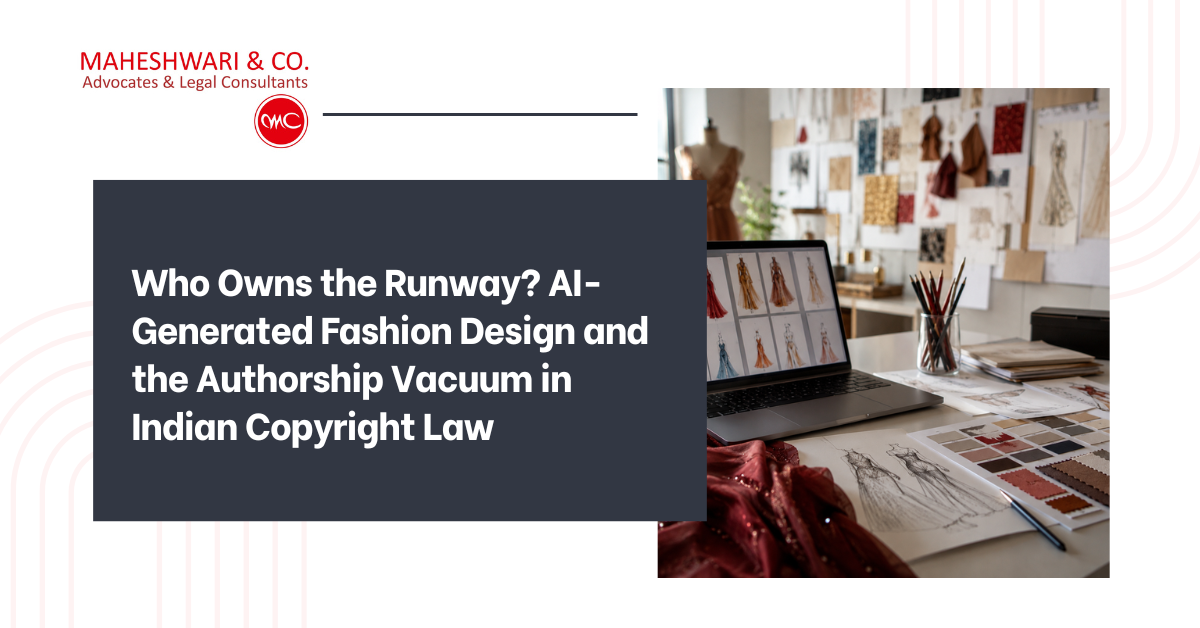
Type a prompt into any generative artificial intelligence program requesting for an elegant red chiffon dress with a chiffon overlay, bell sleeves and intricate sequin detailing. A finished design would be produced within seconds, with several options for colours, different textile prints and unique silhouettes drawn from millions of scraped images, photographs from the runway and designer sketches. Copyright of these belong to the real designers and photographers, who have never been approached for any consent whatsoever prior to such usage. Such instances lead to two fundamental questions. Did the AI model unlawfully use someone else’s copyrighted work to produce its results? And if it did not, who is the actual owner of the result – the prompter, the AI model, or no one at all?
Indian copyright law has no settled answer to either of these questions, and fashion is where the absence will be felt first.
Current Indian Fashion-IP Architecture
Before asking how AI disrupts fashion’s IP framework, it helps to see what that framework already looks like, since Indian law was a patchwork before AI arrived. Fashion sits across two statutes that were never designed to work together. Section 13 of the Copyright Act, 1957[1] read with “artistic work” in Section 2(c) of the Copyright Act, 1957[2] protects original artistic works sketches, illustrations, surface patterns and art work. The Designs Act, 2000 separately protects an article’s visual appearance once industrially produced, such as the shape, configuration, pattern, ornamentation.
The two regimes actively displace each other. Under Section 15(2) of the Copyright Act[3] , copyright in a design lapse once it has been reproduced more than fifty times industrially, a rule the Delhi High Court affirmed that a registered design forfeits copyright for design-specific rights, while an unregistered one keeps copyright only below that threshold[4]. The case of Ritika Pvt Ltd[5] confirmed the consequence for fashion: once a sketch produces more than fifty garments, its copyright ceases, leaving only whatever the registration-dependent, shorter-term Designs Act offers.
Before generative AI was established, IP protection for Indian fashion was very narrow and fragmented. Laws under the Copyright Regime protected only certain kinds of creative expression, with minute additions from the Design Regime. Several aspects, including functional elements such as silhouettes often received no protection at all. With the advent of AI, the fragmented legal framework could no longer be relied upon and a more coherent and comprehensive approach to copyright protection more pressing than ever.
Crisis One: Did the AI Steal Someone Else’s Work?
The first crisis is input-side: does training on copyrighted runway images without permission infringe copyright? Indian law has no text-and-data-mining exception, so there is no clear answer. Part I of the Working Paper on Generative AI and Copyright released in December 2025 by the Department for Promotion of Industry and Internal Trade (“DPIIT”) asks whether the act of training an AI model, reproduction of such information, storage of such information and adaptation of the same could fall within the exclusive rights under Section 14 of the Copyright Act[6], and whether fair dealing under Section 52(1)(a)[7] of the Copyright Act can cover them.
The proposed solution to this problem could be the hybrid model called “One Nation, One License, One Payment.” This system mandates a compulsory blanket licence for AI developers, allowing third-parties to train their AI models on lawfully accessed copyrighted works. In return, AI developers would have to pay a statutory fee to the Copyright Remuneration Collective for AI Training (“CRCAT”), a centralized body that would distribute royalties to creators and copyright owners. Pertinently, creators do not have the option to opt out of this system, as their copyright works would not be openly available to third-parties in return of receiving a guaranteed compensation – similar to the compulsory licensing system used for broadcasting.
Critics argue that while AI training may not amount to copyright infringement in light of this hybrid model, the proposal lacks clarity on royalty rates and administration. This may lead to benefits solely for AI companies and rather hamper rights of copyright owners and creators – since royalties may not actually match the intellectual value of a work.
Crisis Two: Whose Work Is It Anyway?
Even if training turns out not to infringe, a second question arises once AI generates an output: who owns the new design? Indian law defines “author” as a person, with no provision for AI. One clause comes close: Section 2(d)(vi) of the Copyright Act[8], which was inserted in 1994, credits authorship of a computer-generated work to “the person who causes the work to be created” using language that appears to be specifically designed for prompting. However, it was designed for tools like CAD software, where every creative decision was made by a human and carried out by a machine. Generative AI inverts the earlier models since humans feed in only a few lines of input and most of the creative work is done by the AI model. Whether prompting “causes” a design in the sense the 1994 amendment intended, is a question Indian courts have not answered till date.
The closest India has come is the RAGHAV/Suryast saga[9] case. In 2020, artist Ankit Sahni used an AI tool, RAGHAV, to apply Van Gogh-style elements to his own photograph. The Copyright Office registered the work naming Sahni and RAGHAV as co-authors, briefly making India the first jurisdiction to register an AI as co-author, then sought its withdrawal within a year, citing the requirement that authorship vest in a natural person. No court ever resolved it. Sahni has now sued the Copyright Office again, arguing this time that he alone should be the human author a stronger claim than the one rejected in 2020.
Comparatively, the US refuses registration absent sufficient human control[10], while the UK’s Section 9(3) assigns authorship of a computer-generated work to whoever made “the arrangements necessary for its creation” – this seems to be the most permissive ongoing model. India’s 1994 provision lies in the middle of the two, and it is unclear form a judicial perspective which pole it is closer to.
Why Fashion is a Harder Case Than Fine Art
Most authorship commentary, RAGHAV/Suryast included, concerns a single static image. Fashion can fail twice. Suppose the authorship question resolves in the prompter’s favour, extending the photography analogy to AI-assisted designs with genuine creative selection. Even then, once that design is manufactured at scale, Section 15(2) of the Copyright Act strips copyright past fifty units, leaving only the Designs Act which has no equivalent to Section 2(d)(vi) of the Copyright Act, contemplates nothing computer-generated, and has no position on whether an AI-assisted design can even be registered, or who its “proprietor” would be.
That is the double exclusion in this article’s title. A painting faces one authorship hurdle under one statute; a dress faces that hurdle under the Copyright Act, and then again a second hurdle under a Designs Act that hasn’t begun to grapple with AI. Fine art has one vacuum; fashion has two, stacked, and resolving the first does nothing for the second.
Criticising the DPIIT Working Paper’s Silence
The Working Paper focuses solely on the use of copyrighted works as training data for AI models. The scope is rather limited, since questions of AI authorship and protection for AI-generated outputs have not been dealt with at all in this part of the Working Paper, and are postponed to a proposed Part II of the paper. This creates an important gap for the fashion industry. The paper discusses how designers should be compensated when their works are used to train AI, but it does not address who owns the fashion designs generated by AI or how brands can protect those designs from copying.
Several key questions remain unanswered. If an AI-generated design closely resembles an existing one without being identical, does it infringe copyright? Can an AI-generated sketch receive copyright protection? Can a garment created from an AI-generated design be registered under design law? Part I does not deal with any of these issues. Its proposed licensing system only governs the use of training data and does not address the legal status or protection of AI-generated fashion designs.
Proposed Framework / Recommendations
Three directions are worth pursuing. First, clarify Section 2(d)(vi) by setting a threshold of creative contribution, akin to a photographer’s choices before the shutter, asking whether the human made substantive creative choices rather than leaving this to litigation like Sahni’s. Second, treat input and output as severable questions legislated together, not in sequence, removing fashion’s current asymmetry. Third, and most fashion-specific, amend the Designs Act directly rather than assuming fixed copyright authorship solves design protection too; some have proposed a shorter sui generis term, around fifteen years, vesting in whoever deploys the AI commercially. Without a Designs Act amendment, any fix to Section 2(d)(vi) alone leaves fashion exactly where it stands: protected on paper, unprotected once the design becomes a product.
Conclusion
For now, the runway is legally wide open. A brand using generative AI to design a collection today cannot be certain it owns what the AI produces, nor that the output isn’t already too close to someone else’s work, nor whether either uncertainty will be resolved by Parliament, the courts, or DPIIT’s still-unwritten Part II. The government has legislated the first crisis while leaving the second untouched, and for an industry where copyright and design already sit on a fault line, that omission compounds rather than delays. Part II is where this gets decided.
Author: Akshi Seem, Associate Partner,
Co- Author: Madhulika Bhaskar, Intern
- The Copyright Act 1957, s 13.
- The Copyright Act 1957, s 2 (c).
- The Copyright Act 1957, s 15 (2).
- Microfibres Inc. v. Girdhar & Co 2009 SCC OnLine Del 1647.
- Ritika Pvt Ltd v. Biba Apparels Pvt Ltd (2016) SCC OnLine Del 1979.
- The Copyright Act 1957, s 14.
- The Copyright Act 1957, s 52 (1) (a).
- The Copyright Act 1957, s 2 (d)(vi).
- “Suryast” ROC No. A-135120/2020, Diary No. 13646/2020-CO/A.
- In Re: Application for Registration of SURYAST 88 Fed. Reg. 16191 / U.S. Copyright Office Review Board Decision (December 11, 2023).