
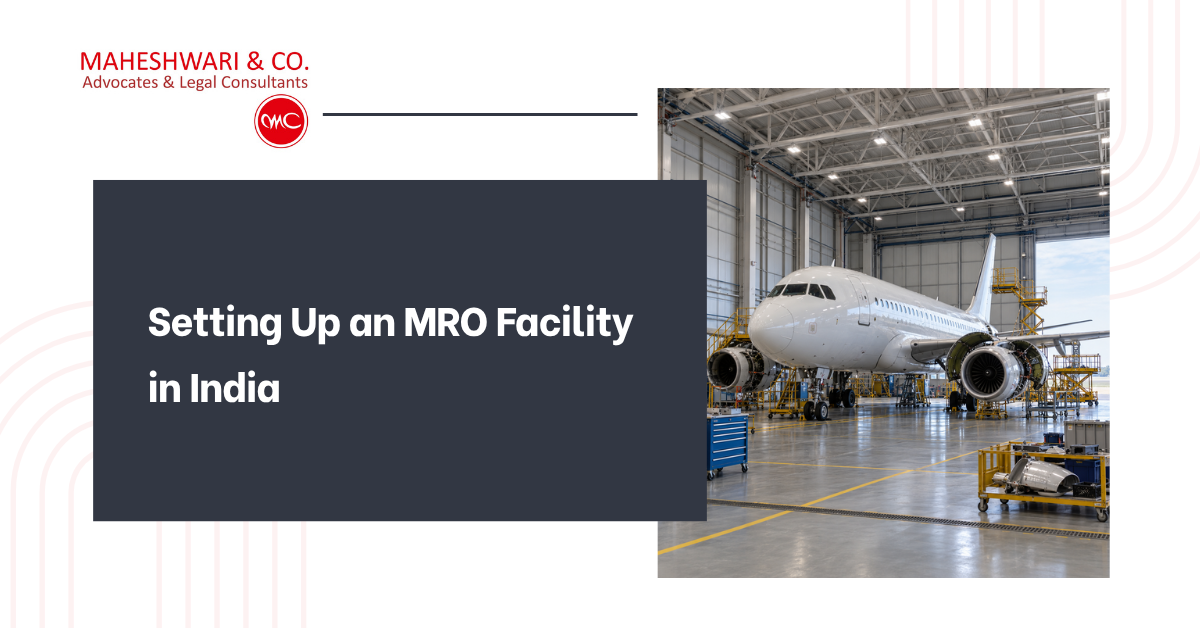

Approvals, Customs and Airport Land, and why the Three of them run on Different Clocks
What does it actually take, in law, to open the doors of an aircraft maintenance facility in India? Most feasibility studies stall at the same point, because promoters treat the project as one licensing exercise when it is really three running in parallel on different clocks. Airworthiness approval sits with the Directorate General of Civil Aviation. Land and airside access sit with the airport operator, which will be either the Airports Authority of India or a private concessionaire holding a state lease. Duty and tax treatment sits with the customs and goods and services tax administration, and that is where the margin is usually won or lost. The MRO setup India legal requirements set out below follows that division deliberately, because an applicant who sequences them badly ends up holding a lease over land it cannot build on and a hangar it cannot certify.
The Statute You Are Now Regulated Under
The Aircraft Act, 1934 has been repealed and replaced by the Bharatiya Vayuyan Adhiniyam, 2024, which commenced on 1 January 2025. The Aircraft Rules, 1937 continue in force under the savings provision of the new Act, and that continuity matters more than the change of name. The entire approval architecture for a maintenance business still hangs off Rule 133B of those Rules, which requires that the performance and certification of maintenance of India controlled aircraft and of components intended for fitment to them be carried out only by a maintenance organisation approved by the DGCA. Every other question in this article is downstream of that single requirement.
DGCA CAR-145 Organization Approval
CAR-145 is the instrument through which Rule 133B is administered. It was first issued on 26 January 2005, modelled on EASA Part-145, and has been revised repeatedly to stay aligned with the European text, with Issue 02 dated 8 October 2013 and successive revisions since, including a draft revision circulated for stakeholder comment in January 2024. An applicant is not buying a general license to repair aircraft. DGCA CAR-145 organization approval is granted against a defined scope, and the certificate is only as wide as the ratings and the capability list attached to it.
Scope and Ratings
Approval is issued by class and rating. Class A covers aircraft, split between base maintenance and line maintenance and further split by aircraft category. Class B covers engines and auxiliary power units. Class C covers components in defined trade groups such as hydraulics, avionics, wheels and brakes, and electrical items. Class D covers specialised services, non destructive testing being the common example. A facility that intends to move from line maintenance into base checks, or from component work into engine overhaul, is applying for a variation, not simply expanding its business.
The Positions the Approval Actually Turns On
The regulator assesses named individuals before it assesses buildings. An accountable manager must hold corporate authority to commit the funds needed to meet the standard, which in practice means a director or chief executive rather than a maintenance head. A quality manager must sit independent of production and run an audit programme reaching every part of the organisation. Certifying staff must hold aircraft maintenance engineer licences under CAR-66 with the correct type ratings, together with authorisations issued by the organisation itself. Support staff, planners, inspectors and stores personnel each carry defined competence and training obligations, including human factors training and recurrent training on a fixed cycle.
Facilities, Procedures and the Exposition
The application is built around a Maintenance Organisation Exposition, the document the DGCA approves and against which it later audits. It must describe hangar or workshop accommodation adequate for the planned work and protected from weather, segregated and environmentally controlled stores for serviceable components, calibration control over tooling and test equipment, control of maintenance data at current revision status, a record keeping system, an occurrence reporting procedure, and arrangements governing subcontracted work. Facility inspection follows document review, and the certificate issues only after the organisation demonstrates the system working rather than merely written down.
The Adjacent Approvals
CAR-145 rarely stands alone. An operator wishing to manage continuing airworthiness for its own or customer fleets needs a separate approval under CAR-M. An organisation intending to train and examine its own engineers needs approval under CAR-147. Manufacture of parts, or design change work, moves the applicant into CAR-21 territory. Where the target market includes foreign registered aircraft, DGCA approval alone will not do, since acceptance abroad still depends on parallel certification from the authority of the state of registry, most often EASA or the Federal Aviation Administration.
Corporate Form and Foreign Investment
Foreign direct investment of up to 100 per cent is permitted in maintenance, repair and overhaul under the automatic route, so no prior government approval is required for the equity itself. That relaxation does not displace the separate screening applicable to investors from countries sharing a land border with India, nor the reporting obligations under the Foreign Exchange Management Act, 1999 and the rules made under it. The registrations that follow are ordinary but time sensitive, including incorporation, permanent account number, goods and services tax registration in the state where the facility sits, and an importer exporter code without which no part clears customs.
Airport Land, the Variable That Decides the Economics
Land inside an airport boundary is the hardest input to secure and the one that most often determines whether a project is viable at all.
At airports operated by the Airports Authority of India, the governing document is the set of MRO Guidelines issued on 1 September 2021, which reset the terms materially. Royalty on MRO turnover was abolished. Allotment on request was replaced by open tender. Land is offered for thirty years, structured as an initial fifteen year term with provision for a further fifteen years, in place of the earlier three to five year arrangements that could never support hangar finance. Lease rental is discovered through bidding rather than fixed by an internal schedule, with escalation of 15 per cent every three years, and an incumbent operator enjoys a right of first refusal where its bid lies within 15 per cent of the highest bid and it agrees to match that rate. An Addendum issued on 20 February 2026 goes further, granting a moratorium and a rent free period to operators constructing new hangars, which addresses the real problem of paying ground rent through a construction period that generates no revenue.
Two legal points sit behind those commercial terms. Section 12A of the Airports Authority of India Act, 1994 permits the Authority to lease airport premises only with the previous approval of the Central Government, so the transaction is never purely a negotiation with the airport director. And at airports run under public private partnership, such as Delhi, Mumbai, Bengaluru and Hyderabad, the Authority is not the counterparty at all. Land there flows from the concessionaire under its operation, management and development agreement and the underlying state lease, on tenure that cannot exceed the concession period, and at rent that is commercially negotiated rather than tariff regulated, since the remit of the Airports Economic Regulatory Authority of India under its 2008 statute does not ordinarily extend to maintenance rentals.
Construction brings its own clearance. A hangar is a tall structure standing close to a movement area, and the Ministry of Civil Aviation (Height Restrictions for Safeguarding of Aircraft Operations) Rules, 2015, notified by GSR 751(E) dated 30 September 2015, require a height clearance no objection certificate for structures within the notified radius around an aerodrome, obtained through the online NOCAS system on the basis of surveyed coordinates and elevation. Sites outside the perimeter raise a further question no certificate can solve, which is whether the airport operator will build and permit a taxiway link. A maintenance facility that aircraft cannot taxi to is a workshop.
Customs, the Second Regulator of an MRO
Customs treatment has moved decisively in favour of the sector, and the current position reads as a package rather than a list of concessions.
Basic customs duty exemption on parts, components, testing equipment, tools and tool kits imported for maintenance, repair and overhaul now runs to 31 March 2028. The chronic inverted duty problem was cured by Notification No. 28/2024-Customs dated 12 July 2024, which amended Notification No. 50/2017-Customs to apply a uniform integrated tax rate of 5 per cent to imports of aircraft parts, components, testing equipment, tools and tool kits irrespective of their classification, with effect from 15 July 2024. Before that change, inputs entering at 12, 18 and 28 per cent against an output service taxed at 5 per cent left credit stranded on the balance sheet of every Indian MRO. The Union Budget presented in 2026 extended the same logic upstream, exempting basic customs duty on components and parts for the manufacture of civilian and training aircraft and on raw materials for the manufacture of aircraft parts used in defence maintenance.
Timelines were relaxed alongside the rates. Goods imported for repair may now remain and be exported within one year rather than six months, and goods sent abroad for repair under warranty may be brought back within five years rather than three. Foreign registered aircraft may remain in India for up to six months for maintenance, which is what makes a genuine third country customer base possible at all. Where capital equipment and inventory are heavy, a private bonded warehouse under Sections 58 and 65 of the Customs Act, 1962, read with the warehouse operations regulations, allows duty and integrated tax on capital goods and inputs to be deferred rather than funded upfront.
Two judicial signals should shape how these benefits are claimed. In InterGlobe Aviation Limited v. Union of India, decided on 4 March 2025, a division bench of the Delhi High Court struck down Notification No. 36/2021-Customs to the extent that it imposed integrated tax and cess on the repair cost of aircraft and parts brought back after overseas repair, holding the additional levy ultra vires because tax had already been discharged on the import of the repair service. The Supreme Court dismissed the revenue challenge to that ruling on 14 July 2025, and the position is now settled.
| Set against that relief, the Constitution Bench in Commissioner of Customs (Import), Mumbai v. Dilip Kumar and Company, (2018) 9 SCC 1, holds that ambiguity in an exemption notification is resolved in favour of the revenue and against the assessee. The consequence for a new MRO is unforgiving. Concessional entries are conditional, the conditions fasten on the identity of the importer as a DGCA approved organisation, on actual end use in maintenance, and on documentation and export timelines, and substantial compliance is not a defence. |
Goods and Services Tax on the Output Side
Maintenance, repair and overhaul services in respect of aircraft, aircraft engines and other aircraft components are taxed at 5 per cent with full input tax credit, down from the 18 per cent that once applied. Place of supply for such services rendered to a registered person has been notified under Section 13(13) of the Integrated Goods and Services Tax Act, 2017 as the location of the recipient, which displaces the ordinary performance based rule and allows work physically done in India for a foreign customer to qualify as an export. Work subcontracted to an Indian facility by a foreign original equipment manufacturer or a foreign MRO is treated the same way and is zero rated. Cash flow then depends on procedure rather than principle, so a letter of undertaking should be on file before the first export invoice, and refund claims for unutilised credit belong in the finance function from month one.
Security, Labour, Environment and Fire
Airside operation brings the Bureau of Civil Aviation Security into the picture. Personnel require airport entry passes issued against police verification and prescribed aviation security training, and the access control, vehicle permits and screening arrangements for the facility must fit within the security programme approved for that aerodrome.
State law is where first time applicants are most often caught off guard. A maintenance hangar is a factory. Section 2(k) of the Factories Act, 1948 defines manufacturing process to include repairing and altering any article, so once the workforce and power thresholds are crossed the occupier must obtain approval of plans and a factory licence from the state inspectorate, and must carry the full body of safety, hours and welfare obligations that follow. Painting, paint stripping, plating, engine wash and component cleaning generate effluent and emissions, so consent to establish and consent to operate are required from the State Pollution Control Board under Section 25 of the Water (Prevention and Control of Pollution) Act, 1974 and Section 21 of the Air (Prevention and Control of Pollution) Act, 1981. Authorisation under the Hazardous and Other Wastes (Management and Transboundary Movement) Rules, 2016 covers used oil, solvent residues, sludge and contaminated absorbents. Storage of fuel, solvents, paints and compressed gases needs licensing from the Petroleum and Explosives Safety Organisation under the Petroleum Rules, 2002 and the pressure vessel rules. Local building sanction and fire clearance complete the set.
The Instruments That Govern the Project
| Instrument | What it controls | Date |
| Bharatiya Vayuyan Adhiniyam, 2024 | Replaces the Aircraft Act, 1934 as the parent statute | 1 Jan 2025 |
| Rule 133B, Aircraft Rules, 1937 | Requires DGCA approval for maintenance and its certification | In force |
| CAR-145 | The organisation approval itself, scope, staff, exposition | From 2005 |
| MRO Guidelines and 2026 Addendum | AAI land allotment, tenure, rental, hangar moratorium | 20 Feb 2026 |
| Section 12A, AAI Act, 1994 | Central Government approval for airport leases | In force |
| GSR 751(E) | Height clearance for structures around an aerodrome | 30 Sep 2015 |
| Notification No. 28/2024-Customs | Uniform 5 per cent integrated tax on aircraft parts | 12 Jul 2024 |
| Protection of Interests in Aircraft Objects Act, 2025 | Repairer lien priority under Article 39(1)(a) | 1 May 2025 |
Where This Is Heading
The next phase of competition will not be settled by tax rates, since those have largely converged with global norms. It will be settled by recognition. So long as an Indian certificate travels no further than the Indian register, domestic facilities will keep bidding for foreign work with a second certification cost built into every quotation, and the operators who invest now in dual approval, in engine and component capability rather than line maintenance alone, and in the depth of licensed engineers that base checks demand, are the ones who will be positioned on the day a bilateral safety arrangement with maintenance implementation procedures finally makes one approval sufficient. That is the horizon against which a facility being planned in 2026 should be designed, and it argues for building scope headroom into the hangar, the exposition and the lease from the first day rather than retrofitting it under pressure later.