
The earlier SEBI (Settlement Proceedings) Regulations, 2018 has been replaced by new regulations by SEBI. In exercise of the Powers conferred under various Acts, SEBI has introduced new SEBI (Settlement of Administrative and Civil Proceedings) Regulations, 2026 vide SEBI Notification No. SEBI/LAD-DOP/2026/31 dated on 06th day of October, 2026. This regulation shall come into effect from the 30th day from the date of notification of this regulation in the Official Gazette.
The regulatory notice issued by SEBI can create a reputational and financial risk for the Company as we all know that a notice issued by SEBI regarding Non compliances of the provisions made under Act, Regulations and rules can have major consequences.
There is a minimum settlement amount of ₹3 lakh for a first-time applicant and ₹7 lakh for other applicants under 2018 Regulations, subject to the compliance of other requirements of these regulations.
The changes made under the new regulations i.e. Securities and Exchange Board of India (Settlement of Administrative and Civil Proceedings) Regulations, 2026 provides the more structured methodology regarding calculation of fees for the settlement of proceedings, remedial action and fast track route.
What Changes for an Entity Facing Enforcement?
For years, settling with SEBI felt like negotiating in the dark. Entities knew a settlement was possible but struggled to predict the price, the timing or the conditions.
Qn 1. When does the regulation take effect?
This Regulation shall be effective from the day succeeding the 30th day from the date of Gazette notification (i.e. 7th November 2026).
Qn 2. What Changes are there in calculating the amount for penalty?
The complex matrices are replaced by a direct formula, so the penalty is now easy to calculate. The Settlement amount shall be calculated as per the following formula:
Settlement Amount = Base Amount x (S + R + G + A – M)
The base amount is linked to the minimum statutory penalty prescribed under securities law where:
- S: stage of proceedings under regulation 12
- R: regulatory action factor under regulation 13
- G: gravity of the violation under regulation 14
- A: aggravating factors under regulation 15
- M: mitigating factors under regulation 16
Q 3. Is there any Fast-Track Settlement route?
The SEBI (Settlement Proceedings) Regulations, 2018 route has been replaced by a fast-track mechanism for the non-compliances made by entities such as delayed disclosure filings, formatting errors and procedural reporting lags etc. It introduces violation-based fast-track settlement and a monetary-threshold route for the amounts up to ₹10 lakh where disgorgement and remedial/regulatory terms do not apply.
Qn 4. What happens to the applications which have been made under the 2018 Regulations?
This concept is covered under Regulation 4(3) of SEBI (Settlement of Administrative and Civil Proceedings) Regulations, 2026. The application made under 2018 Regulations shall be filed within 90 days from the commencement of these new regulations (i.e. SEBI (Settlement of Administrative and Civil Proceedings) Regulations, 2026) by the applicant but it shall be ensured that the same application was never filed before under 2018 Regulations.
In short, it gives a second chance for people who missed the old settlement route. They get 90 days from the commencement of new regulations to apply.
The settlement amount for such applications is 20% higher than the amount calculated under regulation 10.
Q5. What is the time limit for filing a settlement application?
As per the earlier regulations regarding settlement of civil proceedings, the application had to be filed within 60 days from the date of show-cause notice or supplementary show-cause notice, whichever was later. According to regulation 4 of SEBI (Settlement of Administrative and Civil Proceedings) Regulations, 2026, the 60 days for filing the application has been replaced with 90 days from service of the show-cause notice or supplementary show-cause notice, whichever is later. The window is therefore 30 days longer.
For Example: A company was served a show-cause notice on 1st Day of January, 2027. A supplementary show-cause notice was served on 20th Day of January, 2027. Then the 90 days run from the later notice, which is 20th Day of January, 2027. The last date is therefore about the 20th Day of April, 2027.
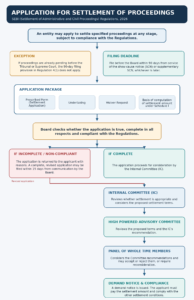
Application for Settlement of Proceedings
Conclusion
The SEBI (Settlement Proceedings) Regulations, 2018 has been replaced with the SEBI (Settlement of Administrative and Civil Proceedings) Regulations, 2026. The purpose of introducing the new regulation is to establish a more structured, transparent and time bound framework for the entities for the settlement of civil proceedings under SEBI laws. The SEBI (Settlement of Administrative and Civil Proceedings) Regulations, 2026 does not cover the proceedings of criminal nature. The new Regulations inserted by SEBI gives a mathematical formula which promotes consistency. It provides the applicant an additional procedural concept for the settlement of civil proceedings through a fast-track route.
Author: Yashika Goyal, Associate
FAQs
1. Which type of proceedings cannot be settled under the SEBI (Settlement of Administrative and Civil Proceedings) Regulations, 2026?
As per the provisions of Regulation 6(1) of new regulations, a proceeding cannot be settled if the applicant has been classified as: 1. willful defaulter or fraudulent borrower by a bank or financial institution under RBI guidelines, or is a fugitive economic offender. 2. where the examination, investigation, inspection or audit is already pending against the same cause of action, 3. where the application of settlement for the same alleged has been previously rejected under these regulations.
On which grounds an application may be rejected by the board under the SEBI (Settlement of Administrative and Civil Proceedings) Regulations, 2026?
As per the provisions of Regulation 7(1) of new regulations, an application may be rejected on the following grounds: 1. where the applicant does not receive or respond to the communications made by board, 2. where the applicant does not submit or delay submit the information, document etc 3. where the applicant required to appear before the IC (Internal Committee) but does not appear for more than one occasion, 4. where the applicant does not remit the settlement amount within specified period, 5. where the applicant violates the provisions of these regulations where the applicant fails to comply with the conditions imposed for settlement within the specified time.