
Introduction: Redefining The Doctrine Of Intermediary Liability
The legal framework governing digital platforms in India has historically been mounted on the shoulders of the principle of “Safe Harbour,” a concept codified under Section 79[1] of the Information Technology Act 2000. This doctrine treated intermediaries as mere passive channels—neutral social landscape providers who were shielded from liability for third-party content, provided they maintained a policy of “due diligence“. However, this essential notion is undergoing a significant transformation.
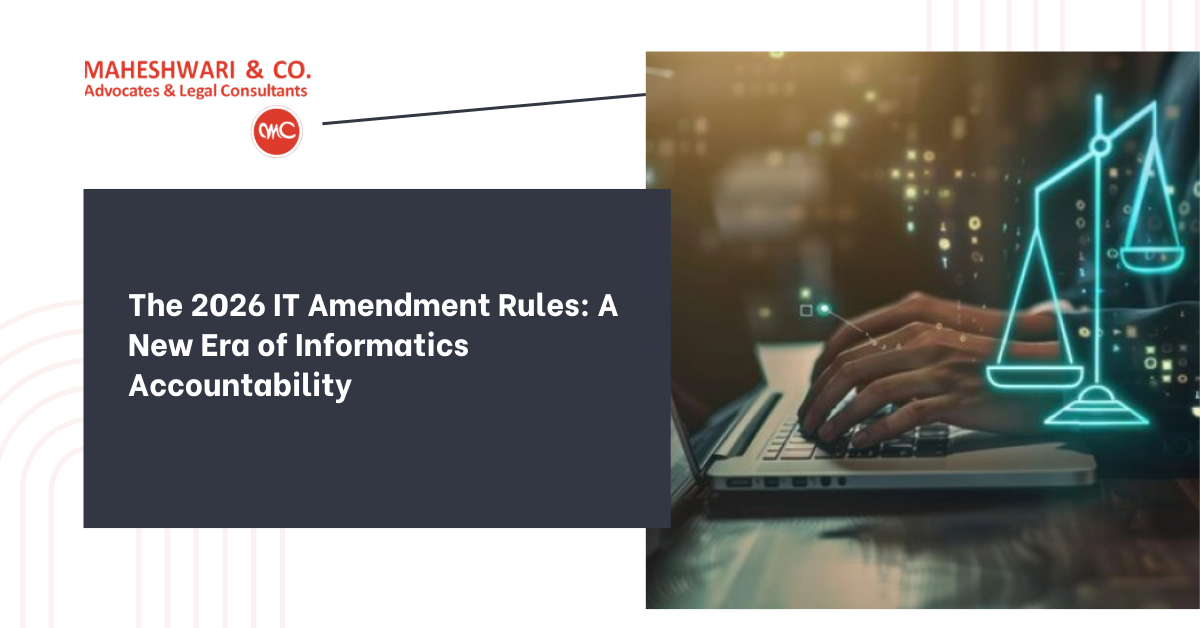
The Ministry of Electronics and Information Technology on, 10th February 2026 has published notification about the Information Technology (Intermediary Guidelines and Digital Media Ethics Code) Amendment Rules, 2026, blurring the boundary between being a passive conduit and an active regulator. The Ministry’s move toward mandating interventions, particularly regarding Synthetically Generated Information (SGI) and hugely minimised takedown windows, signals a transition to a conditional liability structure. In this new landscape, the intermediary is no longer a mere observer of content landing on its platform but is legally positioned as a vigilante sentinel. This blog explores how these recent amendments have redefined the standards of digital due diligence and what this shift means for the future of platform liability in India.
Inception of Synthetically Generated Information
Before moving forward with the blog, we must understand a concept that the 2026 amendments emphasize heavily upon the idea of “synthetically generated information”. SGI means audio, visual or audio-visual information which is artificially or algorithmically created, generated, modified or altered using a computer resource, in a manner that such information appears to be real, authentic or true and depicts or portrays any individual or event in a manner that is, or is likely to be perceived as indistinguishable from a natural person or real-world event[2].
The 2026 amendments include certain exclusions in order to prevent the law from becoming too broad. These exclusions are :-
- Transcription, compression, and technical corrections– which do not change the meaning of the content they only change its format or size.
- Aesthetic adjustments- General editing or enhancements that improve quality or features of any audio or visual information without altering or overly modifying identity of the original information.
- Professional and educational outputs- Any presentation, research report, draft or illustrations of any kind that is being utilised and presented for professional or educational purposes. Such creations shall not result in the generation of false information and records.
New Standards of “AI Due Diligence”
The state has mandated new and stricter rules with the intention to make the intermediaries a more vigilant and proactive part of the system to formalise the use of SGIs. these rules include:-
- Regulation of Labels and Traceability of SGI:-
Under newly inserted rule 3(3), the intermediary shall mandatorily label information that ensures the content presented on their platform is synthetically generated and make sure it is easily noticeable. They shall also take reasonable care in order to curb the users from modifying and removing any such label or any other unique identifiers. - Mandatory User Declaration and Technical Verification Mechanism:-
Under rule 4(1A), prior to publishing any information, a significant social media intermediary (above 5 million users)[3] shall require the user to declare if the content is synthetically generated. It shall install appropriate mechanisms to ensure whether such declaration is authentic with regards to information’s nature, format and source. - The Hour-Glass Mandate;-
Rule 3(1)(d) is the teeth of the amendment rule as it defines when exactly the immunity mentioned in section 79 of the act ends and the proactive role of the intermediaries begins. Any unlawful act committed against the sovereignty and integrity of India, security of the state, friendly relation with foreign states, public order, decency or morality, presented on the platform of the intermediary shall be removed within 3 hours of receipt of the actual Knowledge in form of court order, reasoned intimation in writing by appropriate government or its agency.
According to rule 3(2)(b), if an individual registers a complaint which is of a prima facie nature, that their private visual information, including artificially generated or morphed images, has been exposed without the consent of the individual, the intermediary shall take down the said information within two hours of receiving the complaint. Furthermore the intermediaries are obligated to set up a mechanism for registering such complaints. - A Step Towards Accountability;-
The significant social media intermediaries (SSMI) are now legally obligated to appoint an employee of their own to the position of a “Resident Grievance Officer” in compliance with rule 4(1)(c). This position did not exist prior to the 2026 amendment. SSMI are bound to maintain transparency regarding the contact details of the officer and the mechanism of lodging a complaint. The officer is duty bound to acknowledge the complaint within 24 hours and provide a resolution within seven days of receiving such a complaint.
For the individual not satisfied with the decision of the resident grievance officer, the 2026 amendment under rule 3(3A) provides the individual the opportunity to appeal to the Grievance Appellate Committee, provided the appeal is made within thirty days of the decision of the Grievance Officer. The appeal shall be dealt with promptly and shall be resolved within 30 days of receiving the appeal. This process shall be made available in online mode by the intermediary.
Consequences of Non-Compliance
If an intermediary fails to comply with the above mentioned rules of due diligence which include blocking access of certain content to the public, the Central Government may take action against the intermediary. It shall be liable to be punished for a term which may extend to seven years and/or a fine in accordance with section 69A of the act.
Author – Ketan Joshi, Associate Partner
Co-Author – Hritik Singh, Intern
- https://www.indiacode.nic.in/bitstream/123456789/13116/1/it_act_2000_updated.pdf
- https://www.meity.gov.in/static/uploads/2026/02/550681ab908f8afb135b0ad42816a1c9.pdf
- https://www.meity.gov.in/static/uploads/2024/05/Gazette-Significant-social-media-threshold.pdf