

Introduction
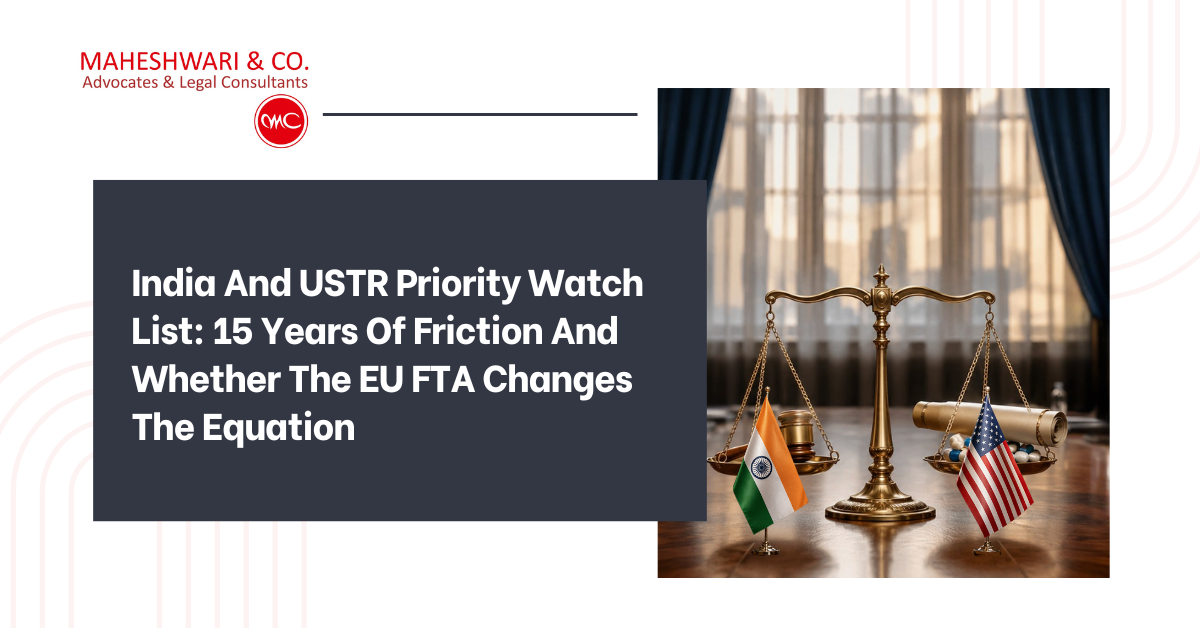
For over 15 years, the United States Trade Representative has retained India on its “Priority Watch List “under the annual special 301 report (a congressionally mandated annual review of the global state of intellectual property rights protection and enforcement). This reflects ongoing US frustration over continuous challenges in India’s intellectual property protection, enforcement gaps and restrictive market access barriers. The clash between them is because of US government strict corporate IP protection laws and India’s efforts to prioritize domestic public interest, affordable healthcare and legal sovereignty. 8 countries are currently on the priority watch list: Argentina, Chile, China, Indonesia, Russia, India, Mexico and Venezuela.
Priority Watch List means countries with serious IP deficiencies that warrant bilateral attention and action plans. Mainly India, China and Russia are historically placed for ongoing market access and counterfeiting issues. The India-EU FTA was signed in January 2026 and stated as “Mother of all deals”. Special 301 status acts as an aggressive diplomatic pressure tool that signals that the US will prioritize heavy bilateral pressure through channels like US-India trade policy forum.
Special 301 Report: Statutory Mandates And Scope
The 301 report is the annual report that is issued by US trade representatives mandated by Section 182 of US Trade Act 1974, which was first published in 1989 with the purpose to identify the countries whose IPR regimes negatively affect US businesses and to encourage improvements in global IP environment. According to section 182 of the Trade Act, the USTR identifies the foreign countries that deny adequate and effective protection of IP rights or deny fair access to US persons who rely on IP protection. That’s why USTR has created a priority watch list under special 301 provisions which indicates that problem exists in that country with respect to IPR protection.
Priority foreign countries are those whose acts, policies or practices are judged to have the adverse impact on US products and can be subjected to formal section 301 investigation and potential trade sanctions. The USTR has warned that it will take action if countries fail to make progress in addressing America’s concern.
India’s 15 Years Presence on The Priority Watch List
India has been on USTR’s priority watch list since 2009-2010 in one or in another form. In 2010 Special 301 report indicated that China, Russia, Algeria, Argentina, Canada, Chile, India, Indonesia, Pakistan, Thailand and Venezuela were on the Priority Watch List. Since that time India has not been removed from the watch list. The USTR report says that India has remained inconsistent in its progress on intellectual property protection and enforcement although India had worked to strengthen its IP laws, India remains one of the world’s most challenging major economies with respect to protection and enforcement of IP. India argued that the report is a unilateral measure taken by US under the Trade Act 1974 to create pressure on countries to increase IPR protection beyond TRIPS agreement.
The Core Legal Disputes
- Patent battle over medicines: India has a rule that you cannot obtain a new patent just by making a minor modification to an already known drug. You have to prove that the new version works better for patients. Big US pharmaceutical companies hate this rule because it prevents them from expanding their monopoly on a drug by making small, insignificant changes to it. India says the rule is perfectly legal under global trade standards and is there to keep medicines affordable. The United States says it does not encourage innovation. This battle has been going on for decades and neither side has budged.
- The battle for compulsory licensing: Indian law allows the government to say to a company “We will allow someone else to manufacture your patented drug without your permission” but only in cases of extreme public interest. India has done exactly this once, for a cancer drug that cost patients nearly Rs. 2.8 lakh per month. After granting the license, a local company manufactured the same drug for Rs. 8800 per month. The patentee still gets ownership rights. The United States is not saying this is illegal and even they can’t because international law allows this but it is concerned that India might do so on a larger and more unpredictable scale, making American companies nervous about investing here.
- The battle against clinical trial data: When a pharmaceutical company develops a new drug, it conducts expensive clinical trials and produces a mountain of safety and efficacy data. The US wants India to give that data a period of exclusivity, meaning no one else can rely on it to get approval for a generic drug, even if the original patent has expired or doesn’t exist. India does not provide such protection and says international law does not require it.
- Battle of trade secrets: If a company’s confidential business information or secret formula is stolen or misused in India, the company must file suit under common contract law or archaic common law principles, there is no law specifically designed to protect trade secrets. The United States has been pressing India for years to pass a proper trade secrets law. India’s response is that existing legal remedies work well and that international rules do not require a specific, independent law. This dispute is less explosive than patent disputes, but it continues to appear in every US report on India.
Why India has Remained on the List For Fifteen Plus Year
From India’s legal standpoint, the USTR’s demands amount to a push for TRIPS plus standards, IP protection that go beyond the minimum requirement established by WTO TRIPS agreement. India has constantly argued that developing countries negotiated and agreed to TRIPS as a package that included specific flexibilities and those flexibilities cannot be unilaterally redefined by a single trading partner through domestic trade report. The USTR picks on countries that have patent laws that would promote their own drug companies and could someday challenge US drug companies for the global market. India is named in the report for its IPA law with regards to patentability period criteria, compulsory licensing criteria and absence of data exclusively.
The India-EU Trade Deal of 2026
India and the EU had been negotiating a trade agreement since 2007. After initial talks collapsed in 2013, negotiations restarted in 2022 and concluded successfully on 27 January 2026. It was a significant achievement covering two economies that together represent a quarter of global output and a market of two billion people. The timing worked well for both parties. India faced American tariffs as high as 50% and sought alternative markets for its exports. The EU, dealing with an unpredictable relationship with Washington aimed to secure a reliable economic partner. Both had strong incentives to make the deal happen.
On intellectual property, the EU secured India’s agreement to a chapter slightly above the international minimum standards, addressing copyright, trademarks, designs and trade secrets. The EU described it as a “strong” agreement that aligns India’s IP standards more closely with Europe. However, India’s official explanation painted a different picture. According to India, the deal does not require any legal changes—data exclusivity for pharmaceutical companies, a long-standing EU demand, is not included. India’s Section 3(d), which prevents trivial patent extensions of medicines, remains unchanged. The country’s ability to issue compulsory licenses during health emergencies is fully preserved, safeguarding its ability to produce affordable generic medicines. In essence, both sides found a compromise: the EU could claim a diplomatic win, while India could honestly state that no fundamental domestic policy changes occurred. Each side managed to declare victory, which is often the norm in large diplomatic negotiations.
Does The EU FTA Change India’s Position With the USTA
The honest answer is that EU FTA does not impact significantly, but it does subtly shift the dynamics.
The EU–India deal places the U.S. in an interesting position. The EU has a powerful pharmaceutical industry and strong IP interests, having spent years trying to get India to adopt stricter data exclusivity and patent standards. Its failure to secure these concessions indicates that such standards are not universal among major trading partners, challenging U.S. negotiators to justify their stance. Meanwhile, U.S.–India trade negotiations continue. Both governments are aiming for a bilateral deal, with a target of reaching $500 billion in trade by 2030. The U.S. has a trade deficit of over $41 billion with India and seeks to reduce it. The Priority Watch List serves more as a negotiation tool now signaling that full trade normalization and tariff reductions might depend on IP reforms.
The realistic outlook suggests India will not overhaul its Patents Act or adopt data exclusivity these moves would be politically damaging and threaten its generic medicines industry. Similarly, the U.S. will not jeopardize its strategic partnerships and alliances with India over pharmaceutical lobbying. Likely, the final agreement will involve India processing patents more quickly, cracking down on piracy and counterfeiting and strengthening trade secret protections—while maintaining its health-oriented IP policies.
Author: Namanveer Singh Sodhi, Senior Associate
Co- Author: Amish Agrawal, Intern