
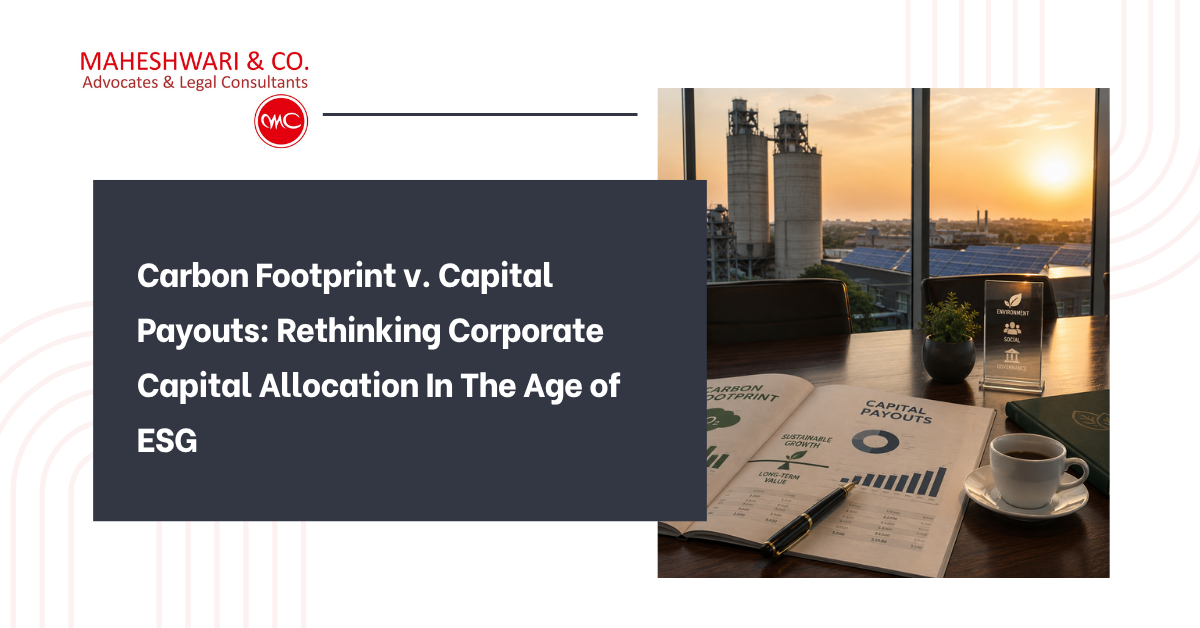

An examination of the emerging tension between shareholder distributions and climate capital expenditure, and a proposal for embedding carbon accountability into India’s corporate payout architecture
Abstract
Year after year, boards around the world find themselves making an often-overlooked but significant decision regarding the portion of the surplus generated during the year which is to be paid out as dividends and buybacks versus the amount which is to be reinvested to decarbonize operations. For many years, such a decision had not been an issue-capital allocation had been about the return on equity, not about carbon emissions. The situation is different today. Regulatory bodies, institutional investors and credit rating agencies have started viewing the carbon footprint of corporations as a financially relevant variable. This article sets out the framework of laws and regulations in respect of corporate pay-outs in India, analyzes the global experience in this area and suggests the use of a “Carbon-Adjusted Payout Ratio” as a governance device for Indian companies.
Two Competing Claims on the Corporate Purse
Traditionally, corporate law has viewed dividend distributions as an issue that was to remain internal to the company and its shareholders. According to the provisions of the Companies Act, 2013, dividend can be declared only from profits after accounting for depreciation and taking into account the restrictions contained in Section 123 of the Act. Share repurchase is permissible under Section 68 of the Act, but it is capped at twenty-five percent of the paid-up capital and free reserves of the company in a financial year. The reason for such limitations on dividends and share buy-backs is that they diminish the cushion available for investment by reducing capital.
There is nowhere in the framework where the statute requires consideration of the source of profit generation for the purpose of making an assessment about whether such profit generation was made in accordance with a decarbonizing strategy of the business, or whether the capital used to distribute profit can actually be used to pay for the refit of the power plant, green power purchase agreements, or the emissions monitoring systems which will be required in the future.
In the past three years, two different and intersecting phenomena have been quietly changing all that. These two phenomena are stricter laws on ESG disclosure and increasingly tough investor expectations in relation to climate transition finance.
The ESG Regulatory Tsunami
India’s main tool for turning carbon performance into a record is the Securities and Exchange Board of India’s Business Responsibility and Sustainability Report (“BRSR”) and its more complex version, BRSR Core. The introduction of the BRSR Core framework was achieved in stages: reporting was voluntary for the 150 largest public companies (by market capitalization) from the FY 2023-24, then it was made applicable to the 250 largest companies in the FY 2024-25, and from the FY 2025-26 onwards, a mandatory report was introduced, which included the ESG report and the value-chain report for suppliers and customers (whose transactions with the company amount to at least two percent of its sales or purchases), applying to the same top public companies. On the contrary, reasonable assurance, which is much more complex and of higher standard than limited assurance used in most countries (including the EU’s Corporate Sustainability Reporting Directive), will be applied in stages, with the supervision of the top 500 companies by the FY 2025-26 and the top 1,000 Company by the FY 2026-27.
In March 2025, SEBI made a further adjustment by changing the wording “assurance” to “assurance or assessment” and by including a new leading indicator that proposes a disclosure regarding the green credits that are generated or bought by the firm and its top ten largest partners in the value chain as well. These are big changes and when the company’s emissions information starts to follow the same evidentiary principles that apply to financial statements and third-party verification and control, the company may find it hard to argue that funding decarbonization is an option when paying out cash to shareholders is not.
To add to the above point, alongside the BRSR there have been efforts being made by India to classify green initiatives. The draft structure that the Department of Economic Affairs published in May 2025 mentions that the country needs to invest USD250 billion per year to make the transition (excluding the infrastructure for electric vehicles and new steel production). In particular, the framework is divided into “Climate Supportive” and “Transition Supportive” phases, where the latter is for sectors like iron or steel, and cement where there is no low-emission production method available yet. In the view of key industry players, if implemented as mandated in 2026, the taxonomy is likely to be seen as a landmark milestone in terms of growth of Indian sustainable finance, enabling blended financing in the market and offering definitional support to lenders.
The trend is similar in other markets as well. In its World Energy Investment 2025 report, the International Energy Agency estimates the figure for total global energy investment at USD 3.3 trillion for 2025, out of which USD 2.2 trillion will go to clean technologies renewables, nuclear energy, grids, storage, low-emission fuels, and electrification, while the remaining amount will be allocated to oil, gas and coal. This means that the figure allocated to clean technologies for 2025 is almost double USD 1.1 trillion intended for oil, gas and coal projects. The situation was quite the opposite only ten years ago, when investments in fossil fuels were remarkably higher than in electricity supply. The shift in the direction of capital is evident, even if capital inflows might be inconsistent across developing markets.
Global Evidence- The Payout Paradox of Big Oil
The conflict between carbon footprint and capital payout can be seen most clearly in the case of the petroleum major companies, which have business activity that relies on fossil fuel extraction and has to deal with transition.
This tension is captured perfectly by the capital framework of Shell for the period of 2025. Thus, the company hopes to return the most of cash flow from operations to shareholders, but it limits its capital expenditures to $20–22 billion per year in the years from 2025 to 2028. Of this money, only around $8 billion is planned to be invested into downstream, renewables and energy solutions, while $12–14 billion will go to upstream and integrated gas.
The case with Exxon Mobil is quite similar. The company declared a four percent increase in its dividend for the fourth quarter of 2025 while going on with its share repurchase plan, having bought around 626 million share worth approximately USD 66 billion since December 2021, even though it adjusted its plans for low-carbon investments due to difficult environmental conditions and policies. Various analysts said that dividends are untouchable for large oil companies since they ensure capital discipline, while buybacks are voluntary and thus, they are the first option for companies to undertake in difficult conditions.
Oil producing corporations in general do not behave inappropriately; their payment schemes comply with the law and articles of association. The most important point, however, is structural: even firms that have publicly claimed to be committed to zero net emissions treat payouts to investors as the most important use of free cash flow, with expenditures on emissions reduction as a residual category. Whether this distribution survives the next decade of increased disclosure, lawsuits, and demands from shareholders is exactly the governance question boards of companies in India should be addressing.
The Indian Mirror – CSR, Stewardship, and the Coming Capital Squeeze
India is currently in possession of two structural levers aiding towards the carbon-conscious allocation of capital, even if the two mechanisms were not created with the archiving of carbon emissions in mind.
The first of these mechanisms is Section 135 of the Companies Act of 2013, whereby certain companies meeting specific market capitalization requirements are required to allocate two percent of their average net profits of the preceding three years towards the corporate social responsibility (CSR) activities of the company. It is important to note that CSR spending is just a small fraction of the ordinary capex or payout budgets of the company since it represents the one instance of Indian company legislation making a statutory allocation of a fixed percentage of profits for a purpose other than benefiting its shareholders or business.
The second is SEBI’s Stewardship Code from 2019 that applies to mutual funds along with all types of alternative investment funds in relation to the investments done in listed equities. According to the Code, institutions must monitor companies concerning various aspects like material environmental, social, and governance risks. It also depends on the guidelines regarding voting policies and the voting histories. With the growth of mutual funds in India being considerable in terms of the market capitalisation that is listed, the Code ensures that institutional investors receive a mandate to question the company regarding its capital allocation policies at meetings, which involves understanding the reason behind the increase in payout in a specific year despite the emissions intensity, as per Scope 1 and 2, remaining unchanged. Rather, at present, neither of the instruments in question makes it mandatory for the board to explain its decision regarding dividend payout or buybacks where carbon performance is concerned. But indications of the fact show that the data related to this question will soon be available in an assured or auditable manner.
The Financial Logic – Cost of Capital and the “Greenium”
To state it again, there is more at play in the carbon credit discussion than simply moral considerations; there are also significant economic factors that need to be acknowledged. It is noteworthy that globally, issuance of sustainable debt (which includes green, social and other bonds) has increased by 186% between 2021 and 2024 to reach 55.9 billion dollars, an indicator that lenders are willing to see low-cost borrowing for transition-related projects.
At the same time, the International Energy Agency draws attention to the fact that cost of financing energy projects in developing countries is still much higher than that in developed states due to the perception of risks associated with policies and currencies; the introduction of the definition system should help reduce this discrepancy in the future.
This situation leads to an unbalanced incentive system for a publicly-held firm. The adverse carbon recording of a firm leads to an increased cost of debt for the firm, reduced value from ESG-compliant investors, and the possibility for missing out on the rising pool of sustainable financing options. All these costs are shared among all shareholders of the firm, including those shareholders who benefitted from high dividends in 2022. As such, large dividends paid out without making enough investment in carbon emission limits can be interpreted as a transfer of costs from shareholders to the company.
Measures
Currently, Indian corporate law does not require any board to evaluate carbon performance in relation to assignments of dividends. This article argues that Indian corporate law should proceed in that direction, without imposing a rigid legal limit on carbon performance.
The first part of the proposal draws on the “say-on-climate” concept, which has become popular in parts of Europe and among certain global institutional investors, under which shareholders are given a vote on a company’s climate transition plan. Indian listed companies that pass the BRSR Core measure should have the option of presenting shareholders with an advisory vote during the annual general meeting and determining whether the CAPR communicated for the year reasonably strikes a balance between the two competing needs of dividend distribution and transition investments. Since this is simply an advisory process, it will enable the board to maintain its full powers under Section 68 and Section 123 of the Indian Companies Act, but it will also create a way for shareholders to be involved in the discussion about finance decision-making in an environmentally friendly way.
In addition, for sectors defined under the “Transition Supportive” classification of India’s soon-to-be launched climate finance taxonomy – iron, steel, and cement being a few – this paper indicates that stock exchanges may need to consider introducing a listing condition making it compulsory for companies presenting proposals for share buybacks or dividend distribution exceeding a certain threshold to attach a board certificate stating that the company has fully funded its investments to transition on its transition path as prescribed by the taxonomy. This merely replicates in terms of the present debt-equity ratio condition applicable to all buybacks under Section 68, replacing the solvency test based on the balance sheet numbers with those based on the transition criteria.
Note that neither of the above proposals requires any primary legislation to be passed. These can be introduced through SEBI circulars, listing requirements, or voluntary resolutions adopted by a company’s board.
Conclusion
The idea of “carbon footprint versus capital returns” suggests that boards have to choose one thing and ignore the other. This view is overly simplistic, and in doing so, it overlooks the more relevant question of whether the distribution policy of the firm allows it to pay for the transition that the firm now acknowledges is necessary. This is not a moral question disguised in the language of finance. It is a question of solvency, just like the debt versus equity test already applied in India in respect of buybacks under Section 68 the only difference being the liability that the company is asked to face; in this particular case, there may be a stranded asset rather than an outstanding debt.
India is in a unique position to tackle this inquiry with statistics rather than emotions. The country has put together nearly all the infrastructure needed to measure the carbon performance of a corporation through BRSR Core’s various assurance requirements, the value chain disclosure mandate, and the draft climate finance taxonomy that is making its way toward approval. What remains to be achieved is the governance practice of checking both BRSR and financial results against each other by asking during the meeting where dividends or buybacks are approved if the capital expenditures for the transition as defined in the company’s BRSR return have indeed been properly funded after the payment.
This is why the contribution of this article needs to be regarded for what it is: not a reflection of the law as it stands, but rather a suggestion about the governance convention which is absent from the law. There has been a movement internationally to favor disclosure-based action instead of crude statutory ceilings, and the recent development of BRSR Core by SEBI, from initially voluntary to mandatory and finally having assurance, is an illustration of how such a convention could eventually become a requirement for listing without enacting any new provision in the Companies Act.
Author: Sheetal Patodiya, Senior Associate, Senior Associate
Co author: Tanishka Bhaskar, Intern