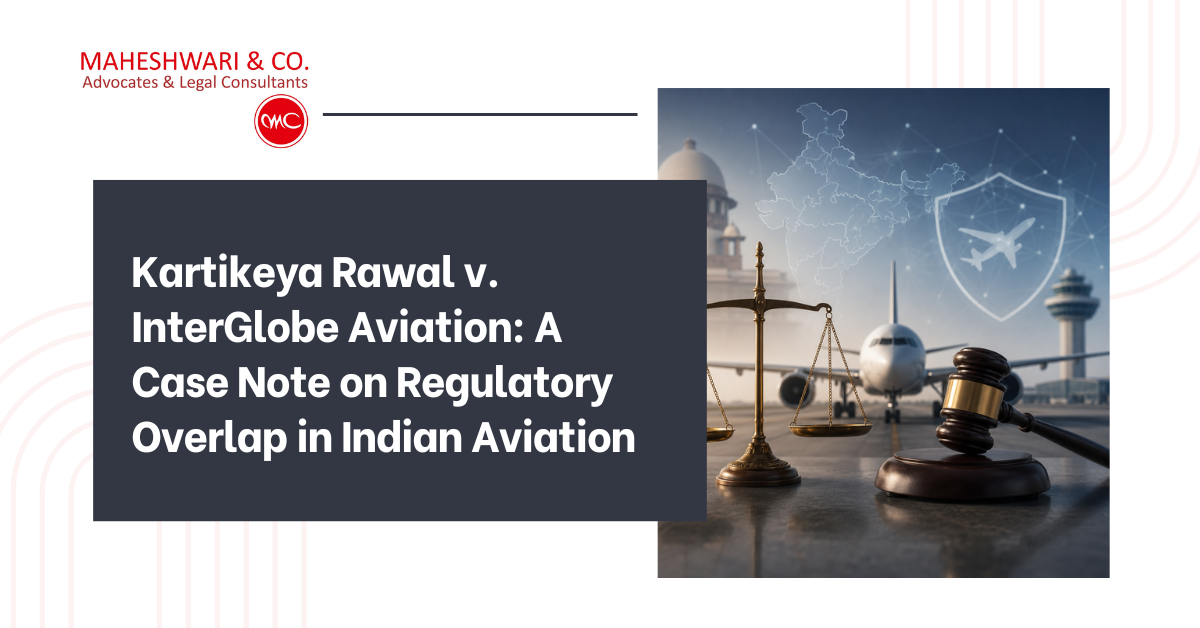

In early December 2025, widespread flight cancellations by IndiGo disrupted domestic air travel across India, leaving thousands of passengers stranded and contributing to a sharp increase in airfares. The operational disruption soon became a legal one for India’s largest carrier. A stranded passenger alleging abuse of dominant position filed a complaint with the Competition Commission of India (CCI). n its preliminary response before the CCI, IndiGo challenged the Commission’s jurisdiction rather than responding to the allegations on their merits. This contention was dismissed by the CCI in its order dated February 4, 2026, in Kartikeya Rawal v. InterGlobe Aviation Limited which clarified the principles governing the Commission’s jurisdiction alongside that of the Directorate General of Civil Aviation (DGCA).
Facts and the Case History
The legal discussion stemmed from the grievance of an individual passenger. Kartikeya Rawal had purchased an IndiGo ticket for a return journey on the Delhi-Goa-Bengaluru route for INR 7,173/- (Rupees Seven Thousand One Hundred and Seventy-Three only). The flights were cancelled just hours before departure, without offering any alternate arrangements. When he tried to rebook, he found that IndiGo’s own fares on the same route had risen sharply, which forced him to travel two days later at a fare of ₹17,000. The hike experienced by him was far from unique because IndiGo’s cancellations that week affected an estimated three lakh passengers nationwide. The Ministry of Civil Aviation later fined the airline over ₹22 crore for the disruption. Rawal, in his complaint, filed under Section 19(1)(a) of the Competition Act, 2002, alleged that IndiGo’s conduct of cancelling its own flights without offering an alternate option and then charging inflated fares amounted to abuse of dominant position under Section 4 of the Act.
IndiGo’s Objection: CCI’s Jurisdictional Threshold
Rather than responding to the allegations on their merits, IndiGo raised a preliminary objection challenging the Commission’s jurisdiction. IndiGo’s central argument was that the Bhartiya Vayuyan Adhiniyam, 2024 (BVA), read with the Aircraft Rules, 1937, constitutes a complete and self-contained regulatory regime for civil aviation, which already covers excessive pricing, unfair practices, and oligopolistic conduct. On this pretext, IndiGo contended that Parliament’s enactment of this specialised, later statute impliedly excluded the CCI’s jurisdiction, making any parallel exercise of power by the Commission legally untenable. IndiGo expressly stated Rule 135(4) of the Aircraft Rules, which empowers the DGCA to issue directions to airlines that have set an excessive or predatory rates, as proof that pricing conduct already fell within DGCA’s sphere of authority. IndiGo further submitted that passenger grievances over cancellations belonged before consumer forums, not the CCI. IndiGo also relied on the Delhi High Court’s judgement in Monsanto Holdings Pvt. Ltd. v. CCI and the Supreme Court’s decision in Bharti Airtel Ltd. v. CCI to argue that specialised regulators should occupy the field to the exclusion of the Commission.
Interpreting Rule 135(4) of the Aircraft’s Rule, 1947
To understand the Commission’s order, it becomes important to unpack what Rule 135 actually does. Sub-rules (1) to (3) require airlines to fix tariffs with respect to the cost of operation and prevailing rates, transparently publish them, and maintain inspection records. The Sub-rule (4) allows the DGCA to issue directions where it is satisfied that an airline has established an excessive or predatory tariff, or engaged in oligopolistic practice. When read in isolation, Sub-rule (4) sounds like competition-law territory. But the Commission held that a holistic reading of the provision shows its purpose is confined to tariff formulation, disclosure, transparency, and the power under sub-rule (4) is corrective and supervisory, not an adjudicatory determination of dominance or anti-competitive conduct. The Commission held that the mere presence of words like “excessive,” “predatory,” or “oligopolistic” in a sectoral rule does not by itself apply competition-law jurisdiction to the sectoral regulator.
DGCA’s Admission on the Limits of its own Regulatory Authorization
Perhaps the most consequential fact in the order came not from IndiGo or the Informant, but from the DGCA itself. In its formal response to the Commission, the DGCA clarified that airfares are not regulated by it, and that it has not been vested with economic regulatory powers over civil aviation and air transport services under the BVA. Its role is limited to and more focused on ensuring tariff transparency, such as mandating that airlines publish tariff sheets on their websites rather than assessing market dominance or pricing abuse. This clarification significantly undermined IndiGo’s jurisdictional objection, as the very regulator upon which IndiGo relied expressly disclaimed the regulatory powers attributed to it.
Reflecting on the Commission’s Jurisdictional Test
Expanding upon the developments, the Commission revisited the Supreme Court’s ruling in Bharti Airtel Ltd v. CCI (2019) and found that the Court had not ousted CCI’s jurisdiction outright, it had distinguished the CCI’s function from that of a sectoral regulator like TRAI, with each statute pursuing a distinct purpose and set of consequences. Drawing further on Haridas Exports v. All India Float Glass Manufacturers’ Association, which held that statutes operating in different fields with different purposes do not impliedly repeal one another, the Commission interpreted Bharti Airtel as recognising that sectoral regulation and competition law may operate in complementary spheres depending upon the nature of the dispute. It further observed that IndiGo’s reliance on Monsanto Holdings was misplaced on the facts. The Commission noted that the aviation sector has never been treated as immune from competition law merely because it is subject to the DGCA’s regulatory oversight. Rather, sectoral regulation and competition law operate in distinct but complementary domains.
Insight on the IndiGo’s Dominance in Domestic Aviation
whether IndiGo occupied a dominant position in the relevant market. Based on market-share data furnished by the DGCA, IndiGo accounted for approximately 60-63% of both passenger volume and available seat kilometres during Financial Years 2023-24 and 2024-25, operated exclusively on more than 330 city-pair routes, maintained the largest fleet in the country with over 400 aircraft, and remained consistently profitable while most competitors reported losses. This combination of scale, network reach, and financial strength led the Commission to form a prima facie view that IndiGo held a dominant position in the relevant market. It also defined the relevant market as domestic air passenger transport services in India, and also reasoned that the disruption was not confined to particular routes but created a system-wide capacity shock.
The Abuse Analysis in view of Statutory Provisions
On the question of abuse, the CCI was of the view that the mass cancellations left passengers with no viable alternatives but to accept last-minute disruption, while IndiGo’s own fares on the same routes rose sharply following a surge in demand. This conduct exhibited by the airlines appeared to violate Section 4(2)(a)(i) of the Act by imposing anti-competitive pricing. The Commission further held that curtailing a significant portion of scheduled capacity through cancellations created artificial scarcity, restricting the provision of service under Section 4(2)(b)(i). This formed the basis of what led the Commission to conclude that it is prima facie a case of contravention. Subsequently, CCI directed the Director General to investigate and report within 90 days, while clarifying that its findings were not a final adjudication on the merits.
Jurisprudential basis: Sectoral Oversight and Competition Law Overlaps
This is not the first time a negotiation of the boundary between sectoral oversight and market regulation has occurred. Similar tensions have played out between the CCI and the Telecom Regulatory Authority of India over interconnect agreements between broadcasters and distributors. Across these cases, courts and the Commission have consistently rejected the proposition that the mere existence of a sectoral regulator automatically excludes the jurisdiction of the CCI. Instead, the courts focus on the nature of the statutory functions performed by the sectoral regulator. They examine whether the relevant statute actually empowers the regulator to determine issues of market dominance and anti-competitive conduct, or whether it is confined to operational, technical, safety or transparency-related matters. Aviation now joins this list, with the Commission affirming that DGCA’s oversight of tariff transparency does not displace its own mandate to examine market power and abuse. The recurring theme across these cases is built on the assumption that specialised, ex-ante sectoral regulation and ex-post competition enforcement serve different purposes, and can and should coexist unless a statute expressly says otherwise.
Conclusion
More broadly, invoking a sector-specific statute is unlikely to succeed as a blanket jurisdictional shield unless that statute genuinely confers the power to assess dominance and anti-competitive effect vis-à-vis the powers that remain the CCI’s specialised domain under the Competition Act, 2002. The decision also signals to regulated entities that extensive sectoral oversight does not, by itself, immunise conduct from competition law scrutiny. Enterprises should therefore engage substantively with the Commission’s proceedings rather than resisting its jurisdiction at the threshold, particularly where the sectoral legislation does not confer the regulatory powers claimed. Viewed holistically, the significance of the Kartikeya Rawal case lies less in its treatment of aviation than in its articulation of a broader jurisdictional principle. The order reinforces that regulatory overlap is not a flaw in India’s institutional framework but an intentional feature designed to ensure that sector-specific regulation and competition law operate in a complementary manner.
Author: shyamli Shukla , Senior Associate
Co-Author: Nitisha Rai, Intern
FAQs
What is abuse of dominant position under Section 4 of the Competition Act?
Section 4 prohibits a dominant enterprise from using its market power unfairly — for instance, by imposing unfair prices or restricting the supply of goods or services. Dominance itself is not illegal; the Act penalises its abuse. In the IndiGo matter, the CCI's prima facie concerns fall under Sections 4(2)(a)(i) and 4(2)(b)(i).
What happens after a CCI prima facie order?
A prima facie order is not a finding of guilt. It directs the Director General to investigate and submit a report — in the IndiGo case, within 90 days. The parties are then heard on the report, and only after that does the Commission decide whether the Act was contravened and what penalties or remedies follow.
Does sectoral regulation exclude competition law in India?
No — not unless the statute expressly ousts the CCI or genuinely empowers the sectoral regulator to decide questions of dominance and anti-competitive conduct. Courts have consistently held that ex-ante sectoral regulation and ex-post competition enforcement serve different purposes and coexist. The IndiGo order extends this settled position to aviation.