
I. Introduction
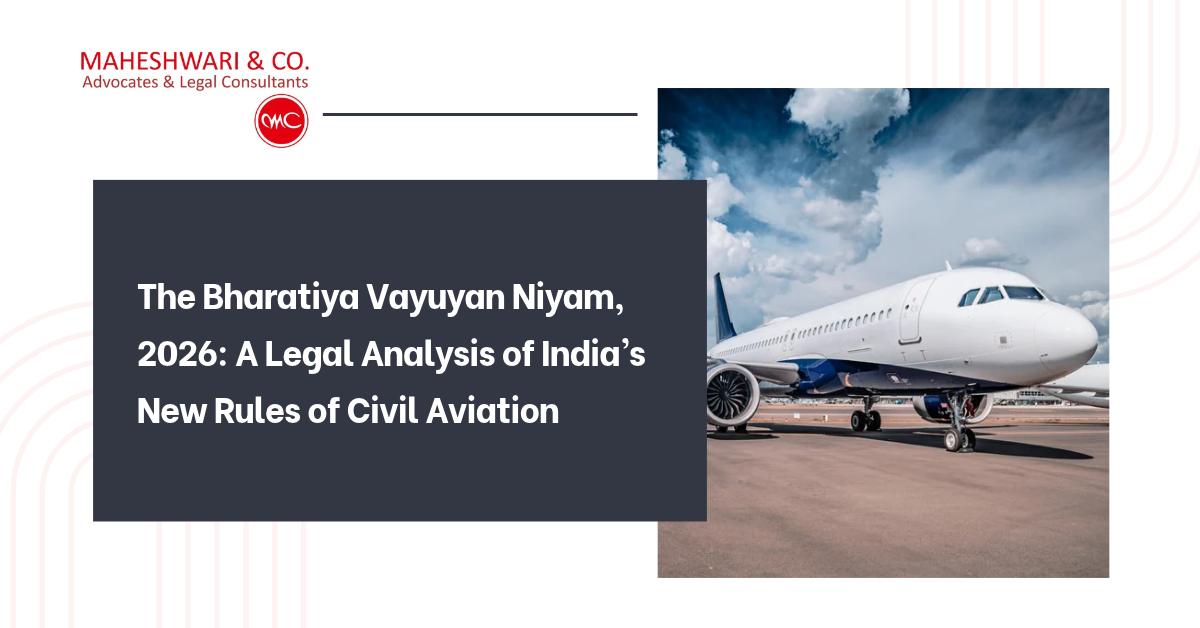
On 31 October 2026, the Ministry of Civil Aviation published the Bharatiya Vayuyan Niyam, 2026 in the Gazette of India. The subordinate legislation takes effect on 1 January 2027 and displaces the Aircraft Rules, 1937, which had regulated Indian civil aviation, with repeated amendments, for almost ninety years. For airlines, lessors, aircraft owners, aerodrome operators, licensed personnel and passengers, the Niyam marks the most significant change to the operational legal framework of Indian aviation in a generation.
II. Background
The Niyam is delegated legislation. Its source of power is the Bharatiya Vayuyan Adhiniyam, 2024, which Parliament passed in December 2024 to replace the Aircraft Act, 1934. The Adhiniyam received Presidential assent on 11 December 2024 and, as reported, came into force on 1 January 2025. Because an Act of this kind sets out broad principles and leaves operational detail to rules, the Adhiniyam could not function fully until a new set of rules was in place. The Niyam fills that gap and also assigns the roles of the Central Government and the Directorate General of Civil Aviation (DGCA).
III. The Niyam at a Glance
| Particulars | Position under the Niyam |
| Instrument | Bharatiya Vayuyan Niyam, 2026, framed under the Bharatiya Vayuyan Adhiniyam, 2024 |
| Notification / Gazette | Notification dated 26 October 2026; published in the Gazette of India on 31 October 2026 |
| Replaces | Aircraft Rules, 1937; Part IX of the Aircraft Rules, 1920; repeals the Radio Telephone Operator (Restricted) Certificate and Licence Rules, 2025, subject to savings |
| Penal framework | 21 punishable offences; imprisonment up to two years, fine up to Rs. 1 crore, or both; 18 are compoundable |
IV. Principal Features
- Registration and identification of aircraft- All aircraft must be registered and display nationality and registration marks. Indian-registered aircraft use the prefix “VT” followed by a hyphen and three letters. The Niyam provides for two categories of registration, depending on ownership and leasing arrangements. Any change in ownership or lessor must be reported to the DGCA. The aircraft may operate only after the registration requirements are fulfilled, unless the DGCA grants written permission otherwise.
- Design, certification and airworthiness- The DGCA may issue type certificates for aircraft, engines and propellers designed in India and validate foreign certificates subject to prescribed conditions. The Niyam also regulates design, manufacturing and maintenance approvals, airworthiness reviews, noise certification and technical logbooks. The DGCA may issue airworthiness directives where safety concerns arise.
- Aircraft leasing, IDERA and shared ownership- Provided the reliance of Indian airlines on leased aircraft, repossession rights are important to lessors. The Protection of Interests in Aircraft Objects Act, 2025 gives effect to the Cape Town Convention in India. The Niyam further provides for IDERA, requiring eligible applications to be processed within five working days. It also allows shared ownership of aircraft, provided responsibility for their operation and maintenance is clearly assigned.
- Personnel licensing, crew and fatigue- The Niyam regulates licences and qualifications across twenty-three categories of aviation personnel. It also prescribes training, medical and examination requirements, flight duty limits and rest periods. Alcohol and specified intoxicants are prohibited within twelve hours before a flight and during duty.
- Aerodromes and air navigation- Aerodromes may be licensed for public or private use. Licensees must maintain an aerodrome manual, obtain prior DGCA approval for safety-relevant changes and allow DGCA inspectors unrestricted access. Provisions on safety management systems, mandatory and voluntary occurrence reporting, laser use near aerodromes, wildlife hazard control and certification of communication, navigation and surveillance facilities complete the operational framework.
- Passenger-facing provisions- Airlines and booking platforms are required to show the full ticket price, including taxes and other charges, and clearly state their cancellation and refund policies. The pilot-in-command has the final say on board, and any interference with crew members is treated as a safety issue.
V. Fare Regulation: The Central Issue
India has allowed airlines to set their own domestic fares since 1994, and the Niyam does not change this arrangement. According to published analyses, the tariff provision preserves the airlines freedom to set fares, requires scheduled operators to file tariffs with the DGCA and to publish them online, and leaves the Central Government with a residual power in the public interest.
That residual power is the most debated element. In exceptional circumstances, the Central Government can issue directions in writing. These directions must be proportionate to the situation and can remain in force only for a specified period. However, the Niyam does not clearly define what qualifies as an extraordinary situation.
VI. Enforcement, Penalties and Procedural Safeguards
The Niyam lists twenty-one punishable offences, each attracting imprisonment of up to two years, a fine of up to Rs. 1 crore, or both. Eighteen of which are compoundable. Penalties follow a graded scale of ten severity levels, ranging extending upto Rs.1,00,00,000. Inspections may be unannounced, and falsification of logbooks and the lending of licences are prohibited. The framework also provides for hearings, appeals and reasoned orders, which will be significant for any licence holder or operator facing suspension, cancellation or penalty.
VII. Transition and Savings
The repeal of the Aircraft Rules, 1937 is subject to savings provisions, and the notification is reported to protect the validity of earlier regulatory actions, approvals and permissions, to the extent they are consistent with the new rules. Stakeholders should not assume, however, that every legacy approval continues unchanged. Each existing permission, certificate and approval should be checked against the text of the savings clause. Much of the technical detail will also sit in Civil Aviation Requirements (CARs) issued by the DGCA under the Niyam, and draft CARs are generally published for thirty days of public comment.
VIII. Compliance Before 1 January 2027
- Airlines and booking platforms- reconfigure booking interfaces and ticket templates to show the total payable amount and its breakup, and confirm tariff-filing and online publication processes.
- Lessors and financiers- revisit lease and security documentation and verify as per IDERA timeline and the Cape Town framework.
- Operators and maintenance organisations- update safety management systems, occurrence-reporting procedures and logbook practices.
- Flight and cabin crew employers- audit duty-time schedules, rest periods and substance-use policies against the new limits.
- Aerodrome operators- review licences, aerodrome manuals, wildlife-hazard programmes and laser-use permissions.
- All stakeholders- monitor DGCA notices and draft CARs, and use the comment windows to raise concerns.
IX. Conclusion
The Niyam brings together several separate rules into one framework under the Bharatiya Vayuyan Adhiniyam, 2024. The Niyam addresses several important areas of aviation regulation, including aircraft design and leasing, while also requiring airlines to maintain transparency in airfares. However, questions remain about the extent of the Government’s power to intervene in fare fixation. The actual limits of this power will become clearer through its implementation and, potentially, judicial interpretation. Its overall effectiveness will also depend on the DGCA’s institutional capacity to certify, inspect and monitor. Stakeholders must use the next two months to review their existing documents and make the necessary preparations.
Author: Shyamli Shukla, Senior Associate
Co- Author: Tanisha Jain, Intern
FAQs
When do the Rules come into force?
On 1 January 2027, replacing the Aircraft Rules, 1937.
What happens to existing licences, approvals and permissions?
They are protected by the saving provisions, provided they are consistent with the Bharatiya Vayuyan Adhiniyam, 2024.
What are the key changes?
One consolidated framework covering registration, airworthiness, licensing, flight operations, safety management, leasing, fares and penalties.
What are the penalties?
Up to 2 years’ imprisonment, a fine of up to ₹1 crore, or both, depending on the offence. Specified offences can be compounded.
What should aviation businesses do before 1 January 2027?
Review licences, approvals, contracts, registration documents and compliance systems, and identify what needs to change.