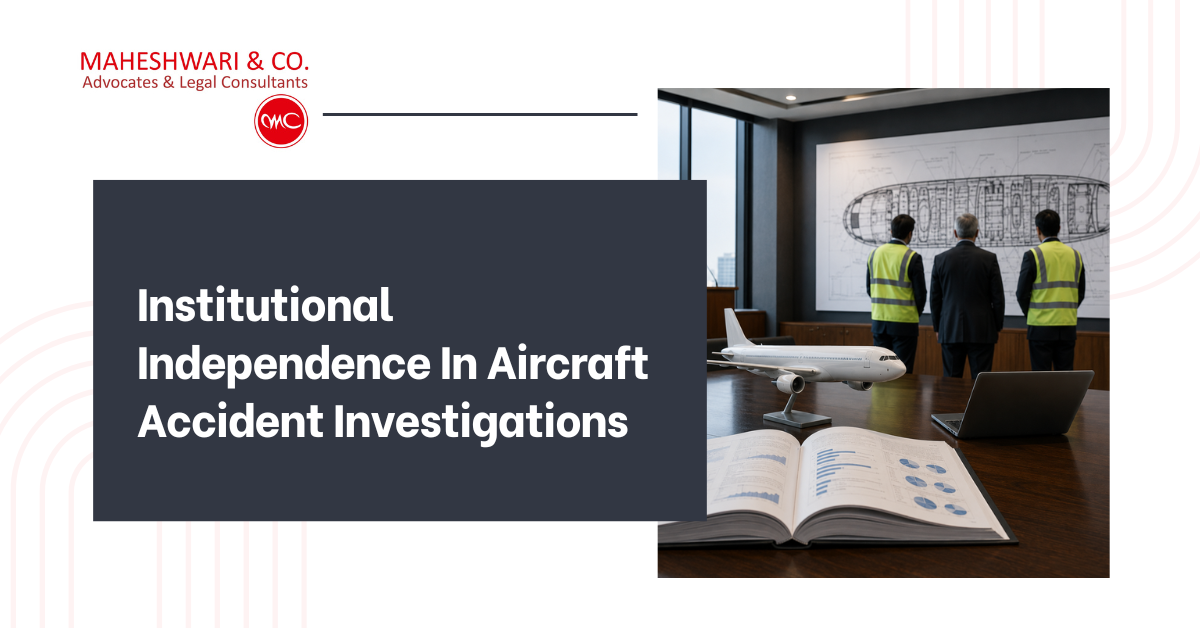

Every civil aviation accident triggers two inquiries: one that seeks accountability, and the other that seeks to determine the cause of the accident. Both of them have a distinct purpose. While the former may lead to regulatory, civil or criminal consequences, the latter is directed towards identifying safety deficiencies to prevent recurrence. The effectiveness of such safety investigations depends not only on technical expertise but also on the institutional independence of the investigating authority from the manufacturer, operator and regulator whose conduct may itself come under scrutiny.
On November 7, 2025, the Aircraft (Investigation of Accidents and Incidents) Rules[1] were notified by the Ministry of Civil Aviation, replacing the earlier 2017 framework, broadly reflecting this principle of safety and aligning with the ICAO’s Annexure 13[2]. The 2025 Rules expressly recognize that the objective of an accident investigation is to improve aviation safety by identifying causes and contributing factors, rather than attributing blame or determining civil or criminal liability.
Why Independence Matters for Aviation Safety
Annexure 13 to the Convention on International Civil Aviation issued by the International Civil Aviation Organization (ICAO) establishes independence as the fundamental pre-requisite for credible findings.[3] The rationale behind this is to ensure that the authority which is involved in regulating airspace, certifying aircraft and licensing operators should be held accountable and face challenges regarding the credibility of its findings, no matter what its conclusions are to ensure procedural integrity.[4] This is the reason various jurisdictions have separated safety investigators from safety regulators.[5] Institutional independence extends beyond the integrity of individual investigators. It also encompasses the organisational framework within which investigations are conducted, including the manner in which investigators are appointed, supervised, funded and authorized to publish their findings. These structural safeguards are essential to maintaining both actual impartiality and public confidence in the investigation process.
What the Aircraft Accident Investigation Rules 2025 Change — and Where They Raise Concern
Under the 2025 rules, the Aircraft AIB has been designated as the primary investigating authority. However, there are two aspects related to it. Rule 11 allows the Director General of the AAIB to appoint an Investigator-in-Charge for the technical investigation, who has the authority gather evidence and access records. Rule 12 authorises the Central Government to initiate a formal investigation when it deems it necessary.[6]
The key issue underlying here is where the decision- making power resides. Although the AAIB functions independently, it operates under the Ministry of Civil Aviation, which consists of the Directorate General of Civil Aviation, who is responsible for certification and oversight. Thus, all the decisions regarding the appointment of the investigator-in-charge, formation of the investigation team, and reference of a matter to formal investigation under Rule 12 ultimately lie with the Central Government.
This framework carries important implications. In the Boeing 737 MAX investigation, scrutiny extended to the FAA’s certification process as well as Boeing’s engineering decisions, an inquiry that a regulator-adjacent investigator would likely find challenging to undertake without constraints[7]. Similarly, the AAIB’s ongoing investigation into the Air India Express Flight AI-171 crash in Ahmedabad has attracted worldwide attention, including parallel involvement by U.S. investigators, thereby testing whether a domestic finding will be regarded as authoritative internationally[8]. Both scenarios highlight a critical point: the credibility of an investigation is contingent on the degree of separation between the investigator and the party under examination.
This observation does not imply that investigations conducted under the 2025 Rules are inherently biased. Here, it is therefore essential to distinguish between actual bias, institutional bias, and the perception of bias, three distinct concepts that are used interchangeably. An investigator can operate impartially while still being situated within a framework that does not visibly separate the fact-finder from the employer of that fact-finder.
Looking Beyond ICAO: Lessons from Other Jurisdictions
The comparison to be made is not between regulatory texts but rather between the institutional frameworks established within different jurisdictions to safeguard the independence of investigation bodies from regulatory authorities.
In the United States, the National Transportation Safety Board (NTSB) operates as an independent federal agency, separate from the Federal Aviation Administration (FAA), which lacks the power to influence or override the findings of the NTSB[9]. In the United Kingdom, the Air Accidents Investigation Branch (AAIB) reports directly to the Secretary of State for Transport, thereby maintaining its independence from the Civil Aviation Authority[10], the entity responsible for certifying aircraft and licensing operators. Similarly, Australia’s Transport Safety Bureau (ATSB) functions as a statutory agency accountable to Parliament, operating independently of the regulatory framework established by the Civil Aviation Safety Authority (CASA)[11].Canada’s Transportation Safety Board (TSB) follows a similar model, reporting to Parliament and disseminating findings without the necessity of regulatory approval[12].
The essential feature common among these agencies is not merely their classification as “independent.” Instead, their independence is fundamentally embedded within their reporting structures, encompassing appointment authority, budget allocation, and the power to publish findings, all of which remain beyond the regulator’s control. This structural design is notably distinct from models that place investigative functions within the same governmental department as the regulatory body, relying on internal safeguards to maintain separation.
Beyond Aviation Law: A Constitutional Perspective to the Issue
This comparative analysis extends beyond aviation law and engages broader constitutional and administrative principles. The concepts of institutional impartiality, the rule against bias (nemo judex in causa sua), and procedural fairness are well-established principles of administrative law. These doctrines recognize that public confidence in administrative decision-making depends not only upon actual fairness but also upon the appearance of fairness. The institutional design adopted by jurisdictions such as the United States, the United Kingdom, Australia and Canada reflects these broader principles by structurally separating accident investigators from aviation regulators.
Thus, the question raised by Rules 11 and 12 is not whether the Central Government has engaged in improper conduct in a particular case. Instead, it examines whether a framework that provides authorization of appointment, supervision, and escalation decisions within the same administrative structure as the regulatory authority can consistently yield findings that convey an assurance of independence, regardless of the specific conduct of any individual investigation.
Independence as a Commercial Imperative
Concerns regarding independence are not merely theoretical in nature; they hold significant implications in reality. Accident investigation reports serve as essential references for various stakeholders, including insurers evaluating risk, lessors examining asset exposure, financiers structuring aircraft-backed transactions, manufacturers addressing airworthiness findings, and foreign regulators determining whether to accept a report before taking action.
Investigation reports are frequently relied upon by insurers assessing liability exposure, lessors evaluating asset risk, financiers structuring aircraft-backed transactions, manufacturers responding to airworthiness concerns, and foreign regulators considering whether to recognize or rely upon another State’s safety findings. Consequently, the institutional credibility of the investigating authority carries significant commercial implications extending well beyond regulatory compliance.
When the institutional independence of a report is subject to scrutiny, the repercussions extend beyond the litigation risks faced by the directly involved parties, affecting the confidence international counterparts place in Indian findings as credible inputs influencing their own decisions. As Indian carriers expand their operations on a global scale, the credibility of the Aircraft Accident Investigation Bureau (AAIB) will play a crucial role, reaching far beyond the boundaries of Indian airspace.
Way Forward
The solution is unlikely to entail a comprehensive amendment of the 2025 Rules, which overall address several key aspects effectively, including the explicit rejection of a mandate focused on assigning fault. However, the framework can be enhanced through a set of targeted institutional safeguards complementing the existing structure, by:
- Establishing objective and transparent criteria governing the appointment of the Investigator-in-Charge, including the publication of reasons where appropriate.
- Providing fixed tenure protections for the leadership of the AAIB, thereby protecting these appointments from routine administrative changes.
- Ensuring that final investigation reports may be published independently without prior regulatory approval, subject only to procedural safeguards prescribed by law.
- Developing a clear and published set of criteria governing the escalation of matters from an AAIB investigation under Rule 11 to a Formal Investigation under Rule 12.
- Instituting a statutory reporting line to Parliament, in addition to the existing administrative reporting structure, to replicate the accountability model utilized in comparable jurisdictions.
None of these proposed adjustments require revisiting the substantive investigative powers outlined in the Rules. Rather, they focus on the structural framework surrounding those powers, which aligns with ICAO’s Annex 13 requirement for independence and the standards observed in international counterparts.
Conclusion
Ultimately, aviation safety depends upon more than technical competence; it also requires confidence in the institutional framework through which investigations are conducted. The Aircraft (Investigation of Accidents and Incidents) Rules, 2025 represent a significant step towards strengthening India’s accident investigation regime by reaffirming its safety-oriented purpose. As India’s aviation sector continues to expand and integrate with the global aviation ecosystem, reinforcing the visible independence of the AAIB through targeted institutional safeguards would further enhance the credibility and international acceptance of India’s aviation safety framework.
Author: Jyotsna Chaturvedi, Head – corporate Practice and Shyamli Shukla, Senior Associate
Co- Author: Shivi Garg, Intern
- MINISTRY OF CIVIL AVIATION, GOV’T OF INDIA, Aircraft (Investigation of Accidents and Incidents) Rules, 2025, G.S.R. 829(E) (Nov. 7, 2025) (India)
- International Civil Aviation Organization, Annex 13 to the Convention on International Civil Aviation: Aircraft Accident and Incident Investigation (12th ed. 2022).
- International Air Transport Association (IATA), Accident and Serious Incident Investigations: Investigator Independence, Paper Presented at the 60th DGCA Asia/Pacific Conference (2025)
- IATA paper to the 60th DGCA Asia/Pacific Conference on Annex 13 obligations and investigator independencehttps://www.icao.int/sites/default/files/APAC/Meetings/2025/2025%20DGCA60/Agenda%20Item03-Aviation%20Safety/60-DP-03-29%20ACCIDENT%20AND%20SERIOUS%20INCIDENT%20INVESTIGATIONS.pdf
- Aircraft Accident Investigation Bureau (India), History of AAIB, Ministry of Civil Aviation, https://www.civilaviation.gov.in/node/4095
- Ministry of Civil Aviation, Aircraft (Investigation of Accidents and Incidents) Rules, 2025, Gazette Notification (Nov. 7, 2025), rr. 11–12
- House Committee on Transportation and Infrastructure, Final Committee Report on the Boeing 737 MAX (Sept 2020), on FAA oversight failures https://www.govinfo.gov/content/pkg/GOVPUB-Y4_T68_2-PURL-gpo144993/pdf/GOVPUB-Y4_T68_2-PURL-gpo144993.pdf
- FAA Statement on Air India Flight AI171 (12 June 2025) https://www.faa.gov/newsroom/faa-statement-air-india-flight-ai171
- 49 C.F.R. § 831.21 (2025).
- Air Accidents Investigation Branch, About Us, GOV.UK, https://www.gov.uk/government/organisations/air-accidents-investigation-branch/about
- Australian Transport Safety Bureau, About the ATSB, https://www.atsb.gov.au/about_atsb/overview
- Transportation Safety Board of Canada, About the TSB, https://www.tsb.gc.ca/eng/qui-about/index.html
FAQs
Who investigates aircraft accidents in India?
The Aircraft Accident Investigation Bureau (AAIB) investigates aircraft accidents in India under the Aircraft Accident Investigation Rules 2025. The AAIB operates under the Ministry of Civil Aviation. Its Director General appoints an Investigator-in-Charge under Rule 11, who gathers evidence and accesses records relevant to the occurrence.
Is the AAIB independent of the DGCA?
The AAIB is functionally independent but not structurally separated from the DGCA. Both sit within the Ministry of Civil Aviation. Decisions on appointing the Investigator-in-Charge, forming the investigation team, and escalating a matter under Rule 12 rest with the Central Government rather than the Bureau.
What is the difference between an AAIB investigation and a formal investigation?
An AAIB investigation under Rule 11 is conducted by the Bureau and led by an Investigator-in-Charge appointed by its Director General. A Formal Investigation under Rule 12 is initiated by the Central Government when it considers this necessary. The 2025 Rules do not publish criteria governing when escalation occurs.
What did the Aircraft Accident Investigation Rules 2025 change?
The Aircraft Accident Investigation Rules 2025, notified on 7 November 2025, replaced the 2017 framework. They designate the AAIB as the primary investigating authority and state expressly that the object of an investigation is to identify causes and contributing factors to improve safety, not to apportion blame or determine liability.
Does ICAO Annex 13 require investigator independence?
ICAO Annex 13 requires that the investigation authority have independence in the conduct of an investigation and unrestricted authority over it. Annex 13 treats independence as a precondition for credible findings. Many States therefore separate the safety investigator from the body that certifies aircraft and licenses operators.